
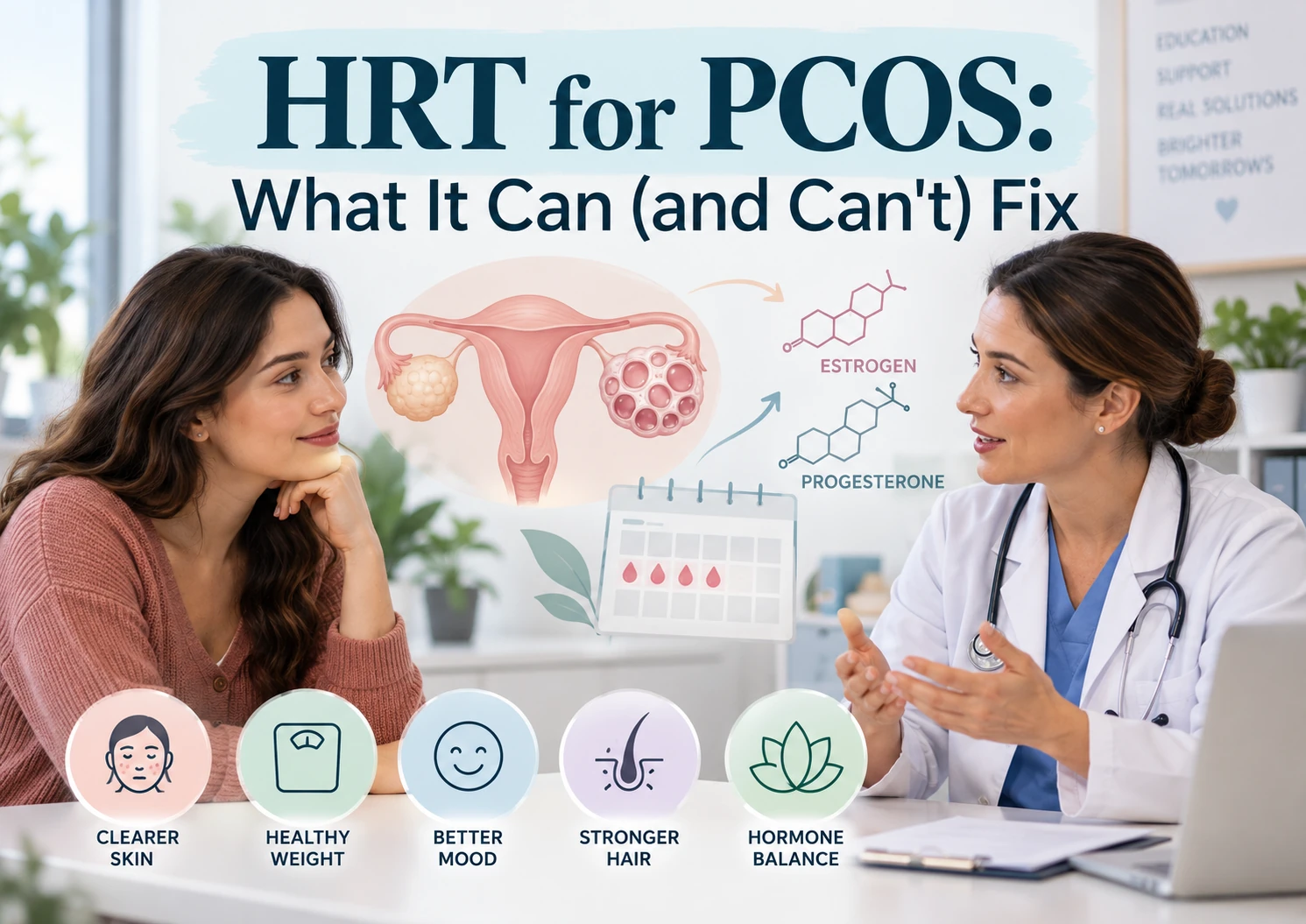
Hormone replacement therapy can ease real PCOS symptoms like irregular cycles, low energy, and mood swings, but it works differently than birth control and isn’t the right fit for everyone.
This guide walks through what HRT actually does for PCOS, who tends to be a good candidate, what testing should come first, and where its limits are, so you know what to ask your own provider.
If you’ve read article after article about PCOS and still feel stuck between “just go on the pill” and “try these supplements,” you’re not alone.
A lot of women end up asking the same question: does hormone replacement therapy for PCOS actually work, or is it just another prescription that treats the surface?
The honest answer is that HRT for PCOS can help, but only when it’s matched to what your own labs actually show.
It isn’t a one-size-fits-all swap for birth control, and it isn’t a cure.
Here’s what it actually does, who it tends to help, and where its limits are.
What Is PCOS, and Why Do Hormones Get So Out of Balance?
PCOS, or polycystic ovary syndrome, is a hormonal condition where the ovaries make higher-than-typical levels of androgens, the hormones most people know as “male hormones” like testosterone.
That often happens alongside insulin resistance.
Together, those two things can stop regular ovulation, which throws off estrogen and progesterone too.
A large global analysis of PCOS prevalence found that roughly one in eight women of reproductive age meet the criteria for PCOS, with rates shifting depending on the region and which diagnostic standard is used.
Doctors look at three things when diagnosing PCOS: irregular or missing periods, higher androgen levels (shown on a blood test or as acne and extra hair growth), and ovaries with multiple small follicles on ultrasound.
You only need two of the three to be diagnosed, which is part of why PCOS can look so different from one woman to the next.
Abnormal estrogen receptor activity in the ovaries is one reason dominant follicles often fail to develop the way they should in PCOS, which is part of why ovulation becomes so irregular to begin with.
Part of the problem is that PCOS doesn’t always announce itself clearly.
Up to 70% of women with PCOS go undiagnosed for years, often because irregular periods or acne get written off as normal instead of investigated as hormone signals.
Can Hormone Replacement Therapy Help Manage PCOS?
Yes, hormone replacement therapy can help manage several PCOS symptoms, including irregular cycles, mood swings, sleep problems, and low libido, by restoring the progesterone, estrogen, and testosterone balance that PCOS disrupts.
It won’t cure PCOS or fix insulin resistance on its own, but for the right candidate, it can make day-to-day symptoms much easier to live with.
That’s a different starting point than what most women are offered first.
Standard PCOS treatment usually leans on hormonal birth control, which regulates periods and lowers androgens using synthetic estrogen and progestin.
HRT for PCOS works on a different premise.
Instead of overriding your cycle with synthetic hormones, it replaces whatever your own hormone panel shows is actually low or imbalanced.
That’s why a personalized hormone replacement therapy plan for women usually starts with lab work, not a prescription pad.
For some women, that means progesterone support to fix a short or irregular luteal phase.
For others heading into their late 30s or 40s, it might mean addressing declining estrogen on top of PCOS symptoms that never fully went away.
Why Birth Control Alone Often Falls Short for PCOS
Hormonal birth control is still considered first-line treatment for the menstrual irregularities and skin symptoms of PCOS, and it does that job well for a lot of women.
The synthetic estrogen and progestin in combination pills suppress ovulation, which regulates bleeding and lowers the androgen levels behind acne and excess hair growth.
What It Leaves Unaddressed
What the pill doesn’t do is touch insulin resistance, which drives a lot of the weight gain, fatigue, and long-term risk that come with PCOS.
Insulin resistance shows up in a large share of women with PCOS regardless of body weight, and it needs its own treatment plan, whether that’s metformin, nutrition changes, or both.
There’s also what happens when you stop.
Some women experience post-birth-control syndrome, a cluster of symptoms like irregular cycles, acne, and hair loss that shows up once the synthetic hormones that were covering for PCOS are gone.
If you’re trying to figure out whether a new hormone plan will stop your periods the way birth control does, that’s a fair question to bring to whoever manages your care, since the answer depends on the specific hormones and doses used.
How Is HRT for PCOS Different From Hormonal Birth Control?
Hormonal birth control uses synthetic estrogen and progestin to override your natural cycle and stop ovulation.
HRT for PCOS typically uses bioidentical hormones, most often progesterone and sometimes testosterone, dosed to correct a deficiency that shows up on your own labs.
One approach suppresses your cycle.
The other tries to correct what’s actually missing.
Bioidentical just means the hormone is molecularly identical to what your body already makes, instead of a synthetic version built to resist being broken down.
For PCOS specifically, that distinction matters because progesterone on its own can help regulate cycles and ease mood symptoms without some of the androgenic side effects that certain synthetic progestins carry.
This is also where a hormone balancing approach differs from a standard prescription: natural support comes first when it’s enough, and bioidentical HRT gets added only when testing shows it’s actually needed.
Who Is a Good Candidate for HRT With PCOS?
The best candidates for HRT with PCOS are women whose lab work shows a clear hormone deficiency, like low progesterone or declining estrogen, rather than women whose main issue is high androgens or insulin resistance alone.
Timing matters too.
What makes sense in your 20s often looks different from what makes sense heading into perimenopause.
During Your Reproductive Years
If you’re still in your reproductive years and not trying to conceive, HRT for PCOS often centers on progesterone support to shorten the gap between periods and ease PMS-like symptoms.
If you are trying to conceive, hormone therapy isn’t a substitute for ovulation induction, where letrozole is generally preferred over clomiphene for better pregnancy outcomes.
Heading Into Perimenopause
PCOS doesn’t disappear once you hit your late 30s or 40s.
It often overlaps with early perimenopause, so symptoms like hot flashes, brain fog, and sleep trouble can stack on top of whatever PCOS was already causing.
If that overlap sounds familiar, it’s worth reading through the symptoms of low estrogen to see how much of what you’re feeling might be a separate, treatable piece of the puzzle.
What Does Hormone Testing for PCOS Involve?
Hormone testing for PCOS typically checks androgens like testosterone and DHEA-S, along with estrogen, progesterone, and markers of insulin resistance such as fasting insulin and glucose.
Looking at all of these together shows which hormones are actually out of range, so treatment can target the real cause instead of following a generic protocol.
The 2023 international guideline for assessing and managing PCOS pushed for exactly this kind of broader workup instead of diagnosing PCOS on symptoms alone and prescribing the same pill to everyone.
That’s the thinking behind specialty testing that maps out your full hormone and metabolic picture before any treatment plan gets built, rather than guessing based on symptoms alone.
Risks, Limitations, and What HRT Won’t Fix
HRT for PCOS has real limits.
It won’t lower your long-term risk for the health issues PCOS is linked to on its own.
Women with PCOS carry a two to threefold higher risk of prediabetes and type 2 diabetes, a nearly fourfold higher risk of sleep apnea, and more than double the risk of depression and anxiety compared to women without it.
None of that improves just by adding progesterone or estrogen.
Insulin resistance usually needs its own plan, whether that’s medical weight loss support, metformin, or changes in how you eat.
A tailored nutrition approach built around PCOS-related insulin resistance tends to move the needle more than hormone therapy alone ever will.
HRT also isn’t something to start without lab work and ongoing monitoring.
Dosing too much or too little, or using the wrong hormone for what’s actually imbalanced, can make symptoms worse instead of better.
This is a plan to build with a provider, not something to piece together from forum posts and guesswork.
How PRIME Medicine Approaches HRT for PCOS
At PRIME Medicine, PCOS never gets treated with a single, generic prescription.
Our naturopathic doctors start with full hormone and metabolic testing, then build a plan around what your results actually show, whether that means bioidentical HRT, insulin support, nutrition changes, or some combination of all three.
This is the same functional medicine thinking we apply across every condition we treat: find what’s actually driving the symptoms before deciding how to treat them.
For PCOS, that usually means looking at your androgens, insulin, and reproductive hormones side by side instead of in isolation.
If you’re in Orange County and tired of being handed the same prescription everyone with PCOS gets, our team of naturopathic providers can walk through your labs with you and explain exactly what a hormone therapy plan built for your specific case would look like.
FAQs: HRT for PCOS
Can HRT replace birth control for PCOS?
Sometimes, but not automatically. If your main symptoms come from low progesterone or declining estrogen, HRT can address that directly instead of suppressing your cycle the way birth control does. If your main issue is high androgens or insulin resistance, birth control or other medications may still play a role alongside hormone therapy.
Is bioidentical HRT safer than the pill for PCOS?
Bioidentical hormones aren’t automatically safer, but they work differently. Because they’re dosed to match what’s actually low on your labs rather than given as a fixed synthetic dose, many women tolerate them with fewer androgenic side effects. Safety still depends on getting the right diagnosis, the right dose, and regular monitoring.
Does HRT help with PCOS weight gain?
HRT can ease symptoms like fatigue and poor sleep that make weight management harder, but it doesn’t directly fix the insulin resistance that drives most PCOS-related weight gain. Pairing hormone therapy with a nutrition plan built around insulin resistance typically works better than either approach alone.
Can you get HRT for PCOS in your 20s and 30s?
Yes. Age isn’t the deciding factor, your hormone levels are. Many women in their 20s and 30s with PCOS have low progesterone from irregular ovulation, which can be addressed with hormone therapy regardless of how far they are from menopause.
What tests are done before starting HRT for PCOS?
A full workup typically checks androgens like testosterone and DHEA-S, along with estrogen, progesterone, and insulin resistance markers like fasting insulin and glucose. Some providers also check thyroid function, since thyroid issues can mimic or worsen PCOS symptoms.
How long does it take for HRT to improve PCOS symptoms?
Most women notice changes in energy, mood, or sleep within a few weeks, while cycle regularity can take a couple of months to settle. You can read more about how long hormone therapy takes to work for a fuller breakdown of what to expect at each stage.
One Response