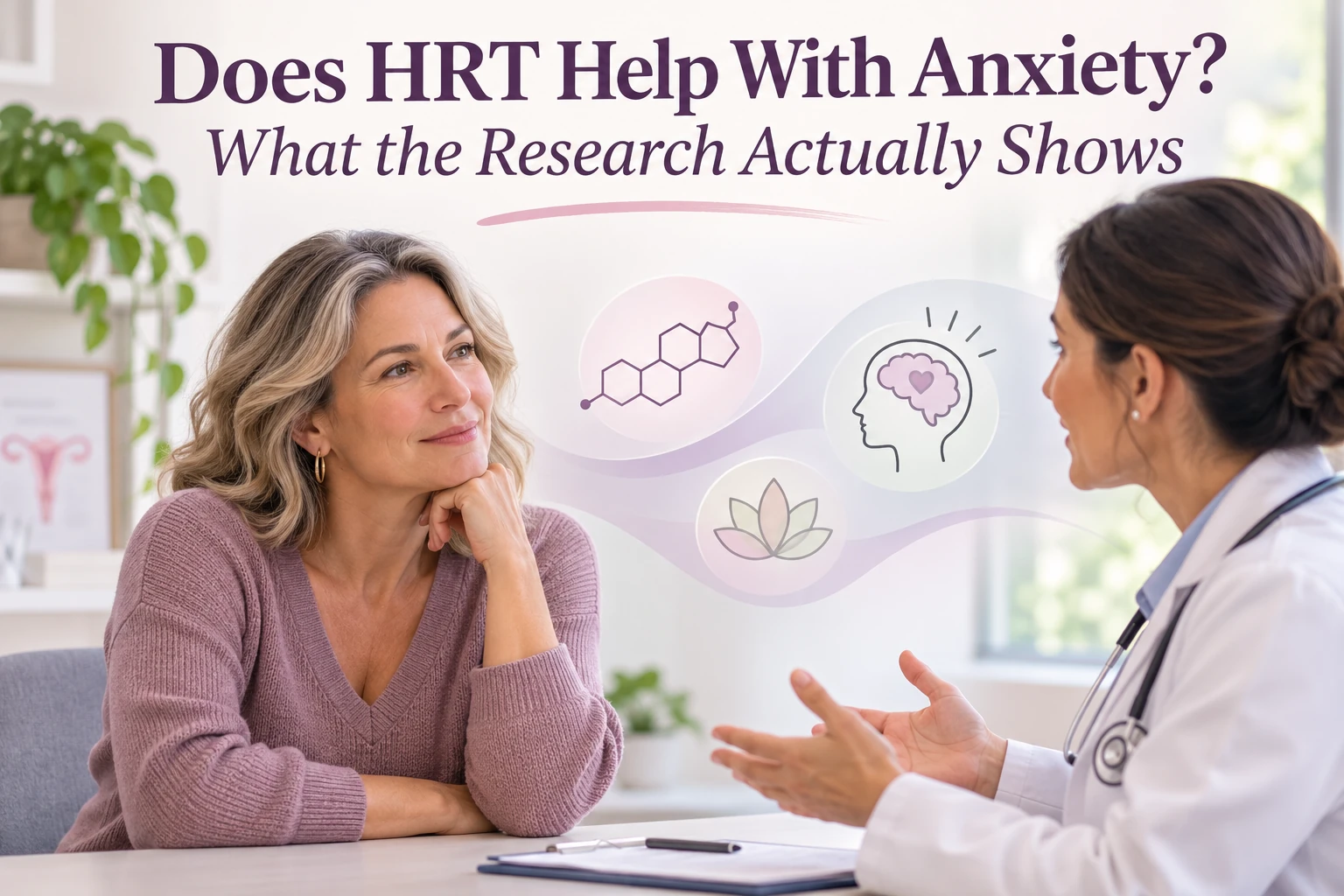
HRT can ease anxiety when it’s driven by hormone swings, especially estrogen and progesterone shifts in perimenopause.
Research is mixed overall, but symptomatic women often see modest, real relief within weeks to a few months.
It works best alongside the right dose, delivery method, and a provider who checks whether your anxiety is actually hormone related.
If you’ve typed does HRT help with anxiety into a search bar at 2 a.m., you already know the feeling isn’t just in your head.
Hormone replacement therapy sits at the center of one of the most debated questions in menopause care, and for good reason.
Some studies show real relief.
Others show no difference at all.
The truth is that the answer depends on where your anxiety is coming from, which is why hormone replacement therapy for women usually starts with figuring out what’s actually driving your symptoms rather than guessing.
Can Hormones Really Affect Your Anxiety Levels?
Yes.
Estrogen and progesterone both act directly on the parts of your brain that control fear and calm, including serotonin activity and the amygdala.
When these hormones swing or drop sharply during perimenopause, anxiety can appear even in people who have never struggled with it before.
Estrogen helps keep serotonin, the chemical most closely tied to steady mood, running smoothly, and it also acts on the amygdala, the brain’s fear center.
Progesterone works differently.
Its breakdown products bind to GABA receptors, the same calming pathway used by anti-anxiety medication.
Somewhere between 15 and 50 percent of women going through perimenopause and menopause report real anxiety symptoms, a wide range that reflects how differently each person’s body responds to shifting hormone levels.
Researchers tracking anxiety disorders in perimenopausal women globally have found that the burden of anxiety in this group has been climbing since 1990 and could rise more than 40 percent by 2035 if current trends continue.
What Does the Research Say About HRT and Anxiety?
The honest answer is that researchers are still working this out.
A systematic review presented to The Menopause Society looked at seven studies covering more than 1,200 women directly treated with hormone therapy, plus observational data from close to 175,000 more.
The conclusion was nuanced: hormone therapy did not consistently reduce anxiety across the board, but it did show modest benefits for perimenopausal and early postmenopausal women who already had noticeable symptoms.
Oral estrogen showed the most promise in that review, though other research complicates the picture.
A separate analysis found that the effect of HRT on anxiety is less clear than its effect on hot flashes or sleep, and that hormone therapy may work better for women who went through surgical menopause than those who reached menopause naturally.
Dosage, delivery method, and how close someone is to their final period all seem to change the outcome.
That inconsistency isn’t a reason to write off HRT.
It’s a sign that anxiety during menopause has more than one cause, and hormones are only part of the story for some women.
How Does HRT Calm Anxiety Symptoms?
HRT calms anxiety mainly through two pathways.
Estrogen helps stabilize serotonin and tone down the brain’s fear response, while progesterone breaks down into compounds that bind to GABA receptors, the same calming system targeted by anti-anxiety medication.
Restoring both hormones can quiet the physical edge that drives a lot of menopausal anxiety.
Estrogen and the Fear Response
When estrogen drops unevenly, the amygdala can become more reactive, making ordinary stress feel bigger than it should.
Low estrogen rarely shows up as anxiety alone.
It tends to travel with a cluster of other symptoms of low estrogen, including hot flashes, brain fog, and disrupted sleep, each of which can make anxiety feel worse.
Progesterone and GABA Receptors
Progesterone’s main calming effect comes from allopregnanolone, a compound your body makes as progesterone breaks down.
It binds to GABA receptors in the brain, slowing down overactive nerve signals and promoting a sense of calm.
Because this same pathway also encourages drowsiness, restoring progesterone often improves sleep too, and better sleep tends to lower anxiety on its own.
How Long Does It Take HRT to Ease Anxiety?
Most people notice some easing of anxiety within a few weeks of starting HRT, though it usually takes about three months for the full effect to settle in.
How long HRT takes to work depends on your dose, your delivery method, and how closely your anxiety is tied to hormone levels in the first place.
Real-world data backs up that timeline.
One study tracking women before and after starting hormone therapy found that 62.3 percent initially scored in the severe range for mood symptoms, a number that dropped to 24.6 percent after about four and a half months of treatment.
Women with the most severe symptoms at the start saw the biggest improvements.
That study didn’t include an untreated comparison group, so it can’t prove hormone therapy alone caused the change.
Still, a drop that size is hard to ignore, especially paired with how many women report feeling calmer within the first few weeks.
Can HRT Make Anxiety Worse Before It Gets Better?
Yes, for some people.
Starting HRT can trigger a short adjustment period where anxiety temporarily spikes, especially if the dose is too high, too low, or the delivery method doesn’t suit your body.
This usually settles within a few weeks as your levels stabilize.
Common triggers include dosage imbalance, the adjustment period itself, added life stress, and poor sleep, all of which can amplify anxiety independently of whether HRT is actually helping.
That overlap is part of why the research on HRT and anxiety is so mixed.
It’s genuinely hard to separate hormone effects from everything else happening in someone’s life at the same time.
If anxiety spikes rather than eases after you start treatment, it’s often a sign of needing a higher dose or a different formulation, not a reason to stop treatment altogether.
Is Your Anxiety Actually Hormone Related?
Not all anxiety is caused by hormones, so HRT won’t resolve anxiety rooted in stress, trauma, or a standalone anxiety disorder.
The clearest sign your anxiety is hormone related is timing: it tends to rise and fall alongside your cycle changes, hot flashes, or other classic perimenopause symptoms.
Guessing based on symptoms alone only goes so far, since anxiety can look identical whether it’s hormone driven or not.
The most reliable way to know for certain is through specialty hormone testing that measures where your estrogen and progesterone actually sit, rather than relying on how you feel on any given day.
What If HRT Doesn’t Fully Resolve Your Anxiety?
HRT was never meant to be a complete treatment for an anxiety disorder, and no major health authority recommends using it as one on its own.
When anxiety doesn’t improve, or only improves partially, combining hormone therapy with talk therapy, exercise, or anti-anxiety medication tends to work better than relying on any single approach.
Duration matters too.
There’s no fixed timeline for how long menopausal anxiety lasts, since it depends on your hormone trajectory, lifestyle, and mental health history.
For women who decide to stay on HRT long term, that choice is usually driven by bone health, heart health, and quality of life altogether, not mood alone.
How PRIME Medicine Approaches Hormone-Related Anxiety
At PRIME Medicine, we don’t start by assuming anxiety is hormonal, and we don’t assume it isn’t either.
We start by testing.
Our providers build hormone balancing plans around your actual lab results, not a standard dose everyone gets handed on day one.
If your anxiety is tied to shifting estrogen and progesterone, we adjust dose and delivery method until your levels, and how you feel, actually line up.
If it isn’t, we’ll tell you that too, and help you find the right next step instead of leaving you on a treatment that isn’t working.
Our team includes providers who specialize in exactly this kind of individualized hormone care, with Orange County locations designed to make ongoing monitoring easy rather than another thing to squeeze into your week.
So does HRT help with anxiety?
For many women whose anxiety is tied to hormone shifts, yes, often in a real and measurable way.
For anxiety rooted in something else, it’s only one piece of the puzzle.
PRIME Medicine can help you figure out which situation you’re actually in, so you’re not guessing with your own mental health.
FAQs: Does HRT Help With Anxiety
Does HRT help with anxiety during perimenopause specifically?
Perimenopause is when HRT tends to help anxiety the most, since this is when estrogen and progesterone swings are often the sharpest. Research shows modest benefits are more likely in perimenopausal and early postmenopausal women who already have noticeable symptoms, compared to women further past menopause.
Can HRT cause anxiety instead of helping it?
It can, usually temporarily. Starting HRT or adjusting your dose can cause a short window of increased anxiety while your body adapts, especially if the dose or delivery method isn’t quite right yet. This typically settles within a few weeks.
How long before I notice less anxiety on HRT?
Many women notice some improvement within a few weeks, though it usually takes about three months to feel the full effect. Results depend on your dose, delivery method, and how closely your anxiety is tied to hormone levels.
Is HRT alone enough to treat an anxiety disorder?
No. HRT isn’t designed or recommended as a standalone treatment for an anxiety disorder. It works best for anxiety tied to hormone changes, and often performs best alongside therapy, lifestyle changes, or medication when anxiety has other causes.
Does it matter if I take oral or transdermal HRT for anxiety?
It can. Some research suggests oral estrogen shows the most consistent benefit for anxiety, while other studies find that differences between delivery methods depend on the individual. A provider can help match the formulation to your symptoms and health history.
Will my anxiety come back if I stop HRT?
If your anxiety was closely tied to hormone levels, it can return when those levels drop again after stopping HRT. This is one reason some women choose to stay on hormone therapy long term, guided by their overall health goals rather than anxiety alone.