
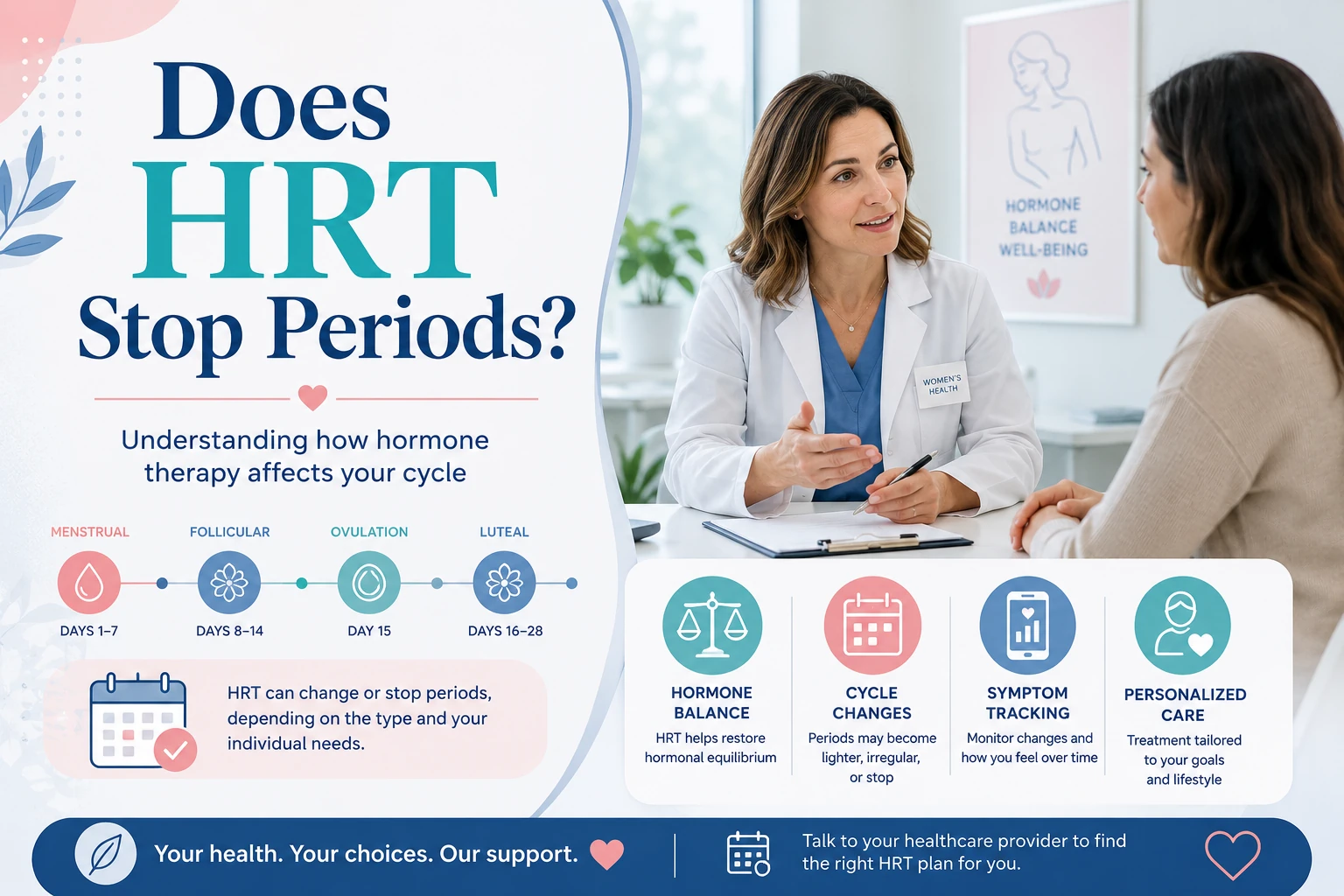
Whether HRT stops your periods depends on the type you’re prescribed.
Cyclical HRT still produces a monthly withdrawal bleed, while continuous combined HRT usually stops periods over the course of several months.
Bleeding patterns vary from person to person, and working with a provider who checks your hormone levels regularly makes the transition easier to predict.
Does HRT Stop Periods?
Hormone replacement therapy can stop your periods, but it depends entirely on the type you’re prescribed.
Continuous combined HRT is designed to stop monthly bleeding over time, while cyclical HRT is designed to produce a regular withdrawal bleed that looks and feels like a period.
Your provider chooses between the two based on where you are in the menopause transition.
If you’re one of the many women asking this question, you’re probably already dealing with hot flashes, night sweats, mood swings, or sleep trouble, and wondering what hormone therapy will do to your cycle on top of everything else.
It’s a fair question, since bleeding on HRT often doesn’t behave the way your periods used to.
A “period” on HRT isn’t actually a period in the biological sense.
Your ovaries aren’t releasing an egg or building up and shedding a uterine lining the way they did before menopause.
Any bleeding you experience is a direct response to the hormones in your prescription, which is why the pattern changes so much depending on how those hormones are dosed.
How Different Types of HRT Affect Your Periods
Most HRT prescriptions fall into one of two categories, and each one affects your cycle in a completely different way.
Cyclical (Sequential) HRT and Withdrawal Bleeds
Cyclical HRT, also called sequential HRT, gives you estrogen every day and adds progesterone for around 12 to 14 days of each month.
When the progesterone stops, your uterine lining sheds, which causes a withdrawal bleed that looks a lot like a period.
This approach is usually reserved for women who are still perimenopausal or who are within the first year of menopause.
The added progesterone isn’t just there to manage timing, either.
Progesterone protects the lining of your uterus from overgrowing, which lowers the risk of endometrial cancer in women who still have a uterus.
Continuous Combined HRT and Period Cessation
Continuous combined HRT gives you both estrogen and progesterone every day, with no break in between.
Because your uterine lining never gets a chance to build up the way it does with cyclical dosing, most women eventually stop bleeding altogether.
This type is generally reserved for women who are already a year past their last period, since starting it too early tends to cause more irregular bleeding rather than less.
Can You Start HRT While You Still Have Periods?
Yes.
Plenty of women start hormone therapy during perimenopause, while their periods are still showing up, just less predictably than before.
In that situation, providers typically reach for cyclical HRT so the treatment works alongside your remaining natural cycle instead of fighting against it.
Continuous combined HRT usually isn’t the right starting point if you’re still getting periods, because it tends to cause more breakthrough bleeding while your ovaries are still producing some hormones of their own.
Cyclical HRT gives your body a more predictable rhythm to follow while your natural cycle winds down.
As your periods become further apart and eventually stop on their own, most providers will talk with you about switching to continuous combined HRT.
There’s no fixed date this has to happen.
It depends on your symptoms, your bleeding pattern, and how your labs look at follow-up visits.
How Long Does It Take for HRT to Stop Your Periods?
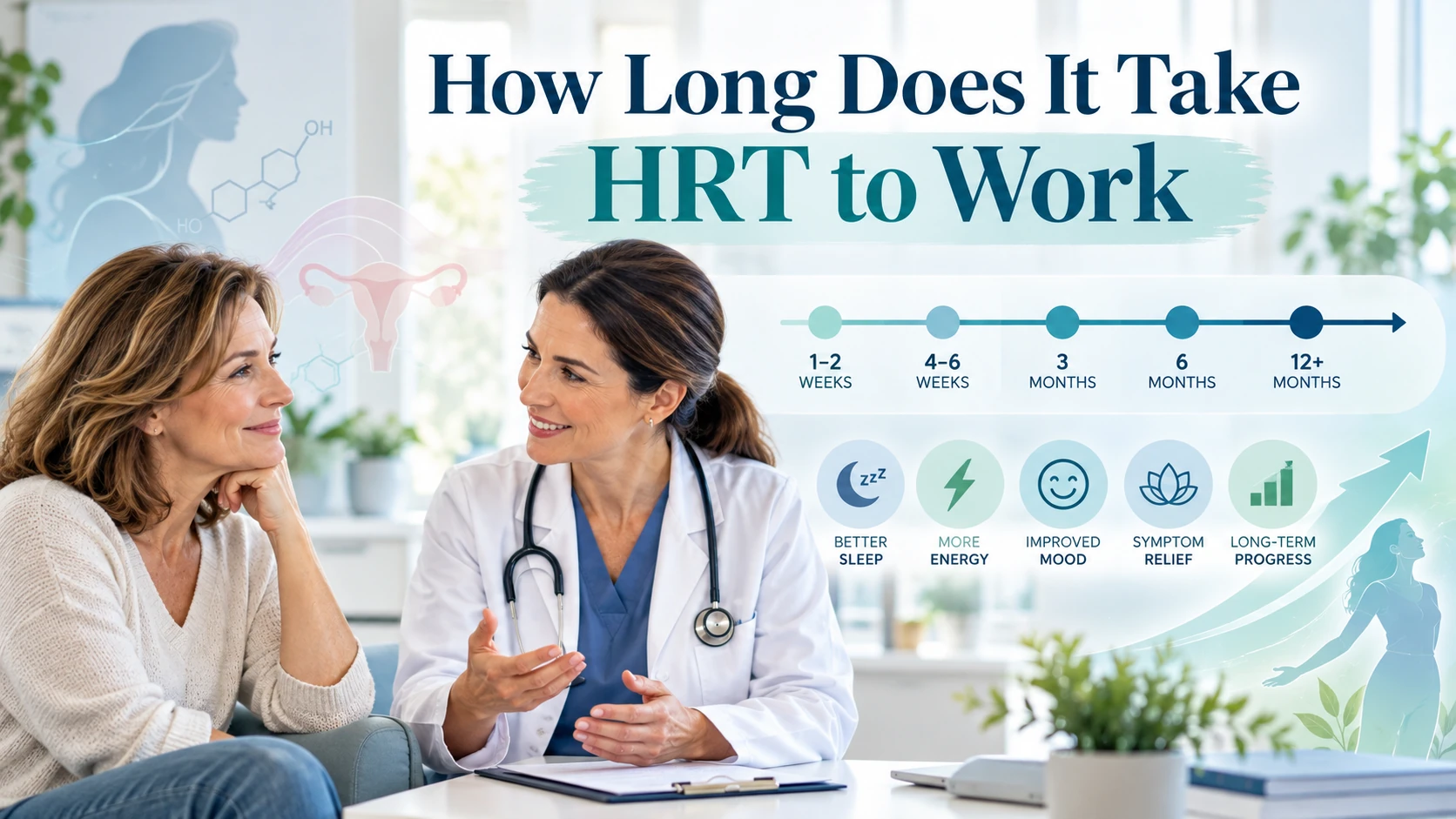
For most women on continuous combined HRT, bleeding patterns take about three to six months to settle down, and periods often stop completely within the first year.
Spotting or light breakthrough bleeding during those early months is common and usually isn’t a sign anything is wrong.
Everyone’s timeline looks a little different.
Some women notice their bleeding taper off within a couple of months, while others see gradual improvement over three to six months before things fully settle.
Your dose, your starting point in menopause, and your individual hormone metabolism all play a role.
If you’re still bleeding heavily or unpredictably well past the six month mark, that’s a good reason to check in with your provider rather than waiting it out on your own.
What Counts as Normal Bleeding on HRT?
Light spotting, occasional breakthrough bleeding, and irregular timing are all considered normal during the first six to twelve months of continuous combined HRT, especially if you started less than a year after your last natural period.
Bleeding is usually only a concern if it’s very heavy, lasts several days, or shows up well after your periods had already stopped.
Breakthrough bleeding in the first year of continuous combined HRT typically doesn’t need to be investigated unless it’s unusually heavy, since your body is still adjusting to a steady hormone level instead of the ups and downs it used to have.
Once you’re a year or more past your last period and your bleeding has settled, any new bleeding is worth mentioning to your provider, even if it’s light.
It’s usually nothing serious, but it’s the kind of change worth ruling other causes out for.
Why Am I Still Bleeding on Continuous HRT?
If you’ve been on continuous combined HRT for a while and you’re still seeing regular bleeding, a few things are usually behind it.
The most common cause is a dose imbalance between your estrogen and progesterone, since too much estrogen relative to progesterone can keep stimulating your uterine lining.
Adjusting the ratio, rather than stopping HRT altogether, usually resolves it.
Starting continuous combined HRT too close to your last natural period is another common reason, since your body may still be producing enough of its own hormones to interfere with the steady dose you’re taking.
Missed doses, inconsistent patch placement, or a gel that isn’t fully absorbing can also throw things off.
Less often, bleeding comes from something unrelated to HRT entirely, like fibroids or polyps.
That’s part of why any new or changing bleeding pattern is worth a conversation with your provider instead of guesswork.
Bioidentical Hormone Therapy and Your Menstrual Cycle
Bioidentical hormones, which are structurally identical to the estrogen and progesterone your body makes naturally, affect your periods the same general way other forms of HRT do.
Cyclical dosing still produces a withdrawal bleed, and continuous dosing is still designed to stop periods over time.
The real difference is in how closely the dose can be customized and monitored, not in whether your periods stop.
Because bioidentical hormones can be compounded into different strengths and combinations, providers have more room to fine-tune your prescription around your actual hormone optimization goals and bloodwork, rather than relying on a single standard dose.
That flexibility is often what makes the difference between bleeding that settles quickly and bleeding that lingers.
How Prime Medicine Personalizes Hormone Replacement Therapy for Women
Every woman’s hormone levels, symptoms, and menstrual history are different, which is exactly why we don’t start anyone on hormone therapy without a full picture of what’s actually going on in her body first.
We see this play out every week with the women we treat across Corona del Mar and the rest of Orange County.
We build every hormone replacement therapy for women plan around a detailed review of your medical history and symptoms, followed by bloodwork that measures where your estrogen, progesterone, and other key hormones actually stand.
From there, we map out a plan around your numbers and your goals, whether that means starting cyclical dosing while you’re still perimenopausal or moving toward a continuous regimen once your periods have stopped.
That plan isn’t static.
We recheck your labs and adjust your hormone balancing plan at follow-up visits, so if your bleeding pattern isn’t settling the way it should, we can fine-tune your dose instead of leaving you to wait it out.
Our providers walk you through what to expect at each step, so you’re never left guessing whether what you’re experiencing is normal.
When to Call Your Doctor About Bleeding on HRT
Call your provider if you’re soaking through protection every hour or two, passing large clots, bleeding for more than seven days straight, or experiencing bleeding along with severe pain.
You should also reach out if new bleeding starts after your periods have already stopped for a year or more, since that pattern is worth checking even though it’s often not serious.
It’s easy to talk yourself out of calling, especially when you’ve already been told some bleeding is normal on HRT.
But a quick check-in costs you very little, and it’s the fastest way to find out whether your dose needs adjusting or whether something else is going on.
Most bleeding changes on HRT settle down with time and the right dose, and staying on hormone therapy long term is safe for many women when it’s monitored properly.
The bigger takeaway is that you don’t have to figure out what’s normal on your own.
If you’re in Corona del Mar, Newport Beach, or elsewhere in Orange County and trying to figure out what your periods will do on hormone therapy, PRIME Medicine can walk you through a plan built around your own bloodwork instead of a generic protocol.
FAQs: Does HRT Stop Periods
Will my periods stop right away when I start HRT?
No. Most women don’t see their periods stop right away, even on continuous combined HRT. It typically takes a few months for your body to adjust, and some bleeding or spotting during that window is common.
Is it normal to bleed more on HRT at first?
Yes, some irregular or heavier bleeding in the first few months of HRT is common, especially if you started less than a year after your last natural period. It usually settles as your body adjusts to a steady hormone level.
Can I get pregnant while on HRT if my periods haven’t stopped?
It’s possible, especially during perimenopause, when your ovaries may still be releasing eggs occasionally. Standard HRT isn’t a reliable form of contraception, so talk with your provider about a separate method if pregnancy is a concern.
Does stopping HRT bring your periods back?
If you stop HRT before you’ve reached natural menopause, your periods may return, since your body may still be producing its own hormones. If you’re already past menopause, stopping HRT typically doesn’t restart periods, since your ovaries are no longer cycling.
What’s the difference between a withdrawal bleed and a real period?
A real period happens when your ovaries release an egg and your body sheds a uterine lining that built up during ovulation. A withdrawal bleed on HRT happens because your hormone dose changes, not because you ovulated, even though the bleeding can look similar.
Should heavy bleeding on HRT worry me?
Heavy bleeding, soaking through protection within an hour or two, or bleeding with large clots is worth calling your provider about. It doesn’t always mean something serious, but it’s not something to just wait out on your own.

2 Responses