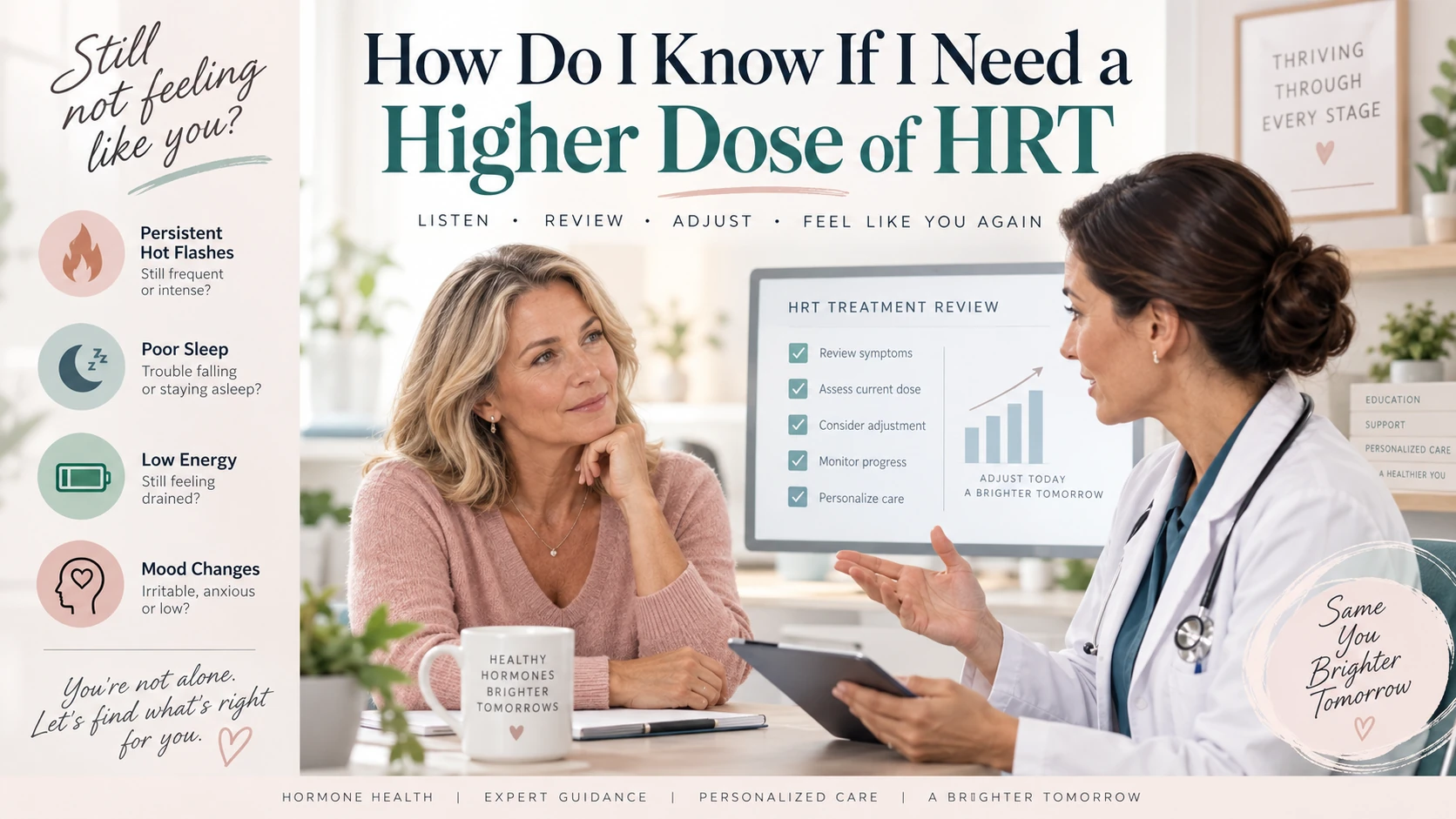
Middle-aged woman reviewing hormone therapy with a doctor, alongside signs such as persistent hot flashes, poor sleep, low energy, and mood changes, with text reading “How Do I Know If I Need a Higher Dose of HRT?”

How Do I Know If I Need a Higher Dose of HRT?

Symptoms that fade for a while and then creep back on hormone replacement therapy often mean your dose needs a second look, but not always.

Absorption problems, vaginal-only symptoms, or another health condition can look almost identical to an underdosed prescription.

Testing and a conversation with your provider, not a self-adjustment, is the safest way to find out.

When you started hormone replacement therapy, you probably expected the hot flashes, night sweats, and brain fog to fade within a few weeks.

If they crept back six months in, or never fully went away, it’s normal to wonder how do I know if I need a higher dose of HRT.

A few different things can look exactly like an underdosed prescription, and telling them apart matters for your safety as much as your comfort.


GET HELP BALANCING YOUR HORMONES


What Are the Signs You Need a Higher Dose of HRT?

The clearest signs are menopause symptoms, such as hot flashes, night sweats, disrupted sleep, brain fog, or low mood, that return or never improve after about three months on a stable dose.

Vaginal dryness, low libido, joint aches, and ongoing bone density loss can also point to a dose that no longer matches what your body needs.

A few patterns show up again and again in women whose dose may need adjusting:

  • Hot flashes and night sweats that never fully went away, or came back after improving
  • Sleep that’s still disrupted months into treatment
  • Brain fog, irritability, or low mood that hasn’t lifted
  • Vaginal dryness or discomfort during sex
  • Low sex drive that hasn’t budged
  • Joint aches that started or worsened around menopause
  • A bone density scan showing ongoing loss despite treatment

Many of these overlap with the symptoms of low estrogen that brought you to HRT in the first place, which is exactly why they’re easy to write off as just how menopause feels.

Joint aches deserve their own mention too, since hormone replacement therapy can ease menopause-related joint pain for a lot of women, and aches that stick around after several months are worth flagging at your next visit.


GET HELP WITH YOUR HRT TREATMENT


How Long Should You Wait Before Increasing Your HRT Dose?

Most providers wait about three months before considering a dose increase, since it takes roughly twelve weeks for hormone levels to reach a steady state in your body.

Some improvement, even partial, in the first four to six weeks is normal and expected.

Zero change by then is worth mentioning at your next appointment rather than waiting the full three months in silence.

Hormone levels don’t jump straight to steady after your first dose.

It generally takes about twelve weeks for estrogen levels to reach a stable, steady state in your bloodstream, which is why most clinicians ask you to hold at a dose for roughly three months before deciding it isn’t working.

That said, you shouldn’t feel nothing for three months straight.

Tracking data from hormone monitoring programs suggests that meaningful symptom improvement usually shows up within four to six weeks, even if it’s partial.

If you’re at week seven with zero change at all, that’s useful information to bring to your provider instead of waiting out the full three months.

The Menopause Society’s most recent position statement is clear that hormone therapy should be individualized and reassessed periodically rather than following one fixed timeline for every patient, so your own pattern of improvement matters more than a date on a calendar.


Could Something Else Be Causing Your Symptoms to Come Back?

Before assuming you need more estrogen, it’s worth ruling out two things that can mimic an underdosed prescription almost perfectly.

Delivery Method and Absorption Problems

How you take your HRT can matter as much as how much you take.

Gel and spray forms need to fully dry on the skin before you dress or shower, and lotion, sunscreen, or oil applied nearby can block absorption.

A patch that’s lifting at the edges, or placed somewhere with less fat under the skin, can also deliver less hormone than the label promises.

Standard estradiol patches are typically dosed from around 0.025 mg to 0.1 mg per day, so a “higher dose” often means moving up within that range rather than doubling anything drastically.

If nausea has been an issue, it’s also worth knowing that switching from an oral tablet to a patch or gel sometimes solves that problem without touching the dose at all.

Other Health Conditions That Mimic Low Hormone Symptoms

Thyroid changes, anemia, sleep apnea, and even anxiety can produce fatigue, brain fog, and night sweats that feel identical to low estrogen.

A broader look at your overall hormone balance rather than estrogen alone often reveals what’s actually driving the symptoms.

Unexpected bleeding changes are worth mentioning too, since not every bleeding pattern on HRT points to a dosing issue, and your provider will want to rule out other causes before changing your prescription.


What Happens When Your HRT Dose Is Too High?

Too much estrogen can cause breast tenderness, nausea, bloating, headaches, mood swings, and breakthrough bleeding.

These symptoms can feel similar to premenstrual discomfort, and they’re your body’s signal that a dose increase went too far rather than a reason to push through it.

Excess estrogen doesn’t just cause discomfort; it can also raise the risk of blood clots, stroke, and breast cancer at doses higher than you actually need, which is why more is never automatically better.

Estrogen can even become less effective at doses above what your body needs, so pushing higher doesn’t guarantee more relief.

Medical guidance from the Menopause Society consistently recommends the lowest dose that actually controls your symptoms rather than the highest dose you can tolerate.

If new side effects show up a few weeks after a dose increase, that’s a reason to call your provider, not to wait it out.

Most dose-related side effects settle within a few months as your body adjusts, but breast tenderness, bloating, or headaches that stick around are worth a follow-up conversation about the dose or the route of administration.


Could You Need Vaginal Estrogen Instead of a Higher Systemic Dose?

If your main leftover symptoms are vaginal dryness, burning, or pain during sex, while hot flashes and sleep have improved, you likely need targeted vaginal estrogen rather than a higher systemic dose.

The two treatments work differently, and increasing your pill, patch, or gel dose won’t necessarily fix a vaginal symptom that a low-dose local treatment resolves directly.

Systemic hormone therapy, the pills, patches, gels, and sprays that raise estrogen throughout your body, is built to calm whole-body symptoms.

One analysis found a 77 percent reduction in hot flash frequency with systemic treatment, which shows how effective it can be for that specific symptom.

Vaginal symptoms are a different story.

Local, low-dose vaginal estrogen is designed to stay mostly in that tissue, and it’s been linked to 60 to 80 percent improvement in genitourinary symptoms like dryness and painful sex.

Raising your systemic dose to chase a vaginal symptom often adds side effects elsewhere without solving the actual problem.

Some women end up using both together once systemic therapy handles the broader symptoms but vaginal dryness lingers, which is a conversation worth having at your next appointment rather than a case for a blanket dose increase.


How Do Providers Decide When to Increase Your Dose?

A good provider looks at more than how you’re feeling today.

They’ll typically review your symptom pattern since your last visit, check hormone levels through targeted lab testing when it’s useful, and weigh your bone health, blood pressure, and personal risk factors before changing anything.

Formulation matters too.

Transdermal patches and gels can carry a different risk profile than oral tablets for clotting and stroke, so a provider might change how you take estrogen before simply raising the dose.

This is also where a broader hormone optimization approach helps, since testosterone, progesterone, thyroid, and cortisol can all influence how well estrogen therapy is working.

Keeping a simple symptom log between visits, noting hot flashes, sleep, mood, and any new side effects, gives your provider real information to work from instead of a vague sense that something feels off.


How Prime Medicine Personalizes HRT Dosing in Orange County

At Prime Medicine, dose decisions never happen off a chart alone.

Every patient starts with comprehensive hormone testing that looks at estrogen, progesterone, testosterone, and the thyroid and adrenal hormones that can quietly affect how HRT feels day to day.

From our Corona del Mar office, we work with women throughout Newport Beach, Irvine, Laguna Beach, Costa Mesa, and the rest of Orange County to build hormone replacement therapy plans around your actual lab results and symptoms, not a standard starting dose applied to everyone who walks in the door.

If your current prescription has stopped working the way it used to, our approach to hormone optimization looks at the full picture: dose, delivery method, and every hormone that interacts with estrogen, so adjustments are based on what your body is actually doing rather than guesswork.

Our providers review your progress at regular follow-ups and adjust as your needs change.


CONTACT US


When Should You Call Your Doctor About Your HRT Dose?

Call your provider if your original symptoms return or never improved after about three months, if you develop new side effects like breast tenderness or unusual bleeding, or if vaginal symptoms persist despite feeling better everywhere else.

Never adjust your own dose between visits, even by splitting a pill or skipping a patch.

Bring specifics to that conversation: when symptoms started or returned, how consistently you’re using your patch, gel, or pill, and anything new since your last visit.

That level of detail helps your provider tell the difference between a genuine dosing issue and one of the look-alikes covered above.

If you’re in Orange County and your hormone therapy isn’t giving you the relief it used to, Prime Medicine can review your labs, your symptoms, and your current regimen to figure out what’s actually going on.


SCHEDULE A CONSULTATION


FAQs: How Do I Know If I Need a Higher Dose of HRT

Will a higher dose of HRT work faster than my current one?

No. A higher dose still takes about the same amount of time, roughly three months, to reach a steady state in your body. It may relieve symptoms a lower dose couldn’t, but it won’t work overnight.

Is it normal for HRT to stop working after a year or two?

Yes, this is fairly common. Your hormone needs can shift as you move further into perimenopause or menopause, so a dose that worked well at first may need adjusting later, especially since many women stay on some form of hormone therapy for years rather than a short fixed course. This isn’t a sign anything went wrong.

Can I just increase my patch or gel dose myself?

No. Adjusting your own dose, even slightly, skips the monitoring that keeps HRT safe, including blood pressure checks and a review of your personal risk factors. Always make dose changes through your provider.

What’s the difference between needing more estrogen and needing more progesterone?

Low estrogen usually shows up as hot flashes, night sweats, and vaginal dryness, while insufficient progesterone often causes irregular bleeding or breast tenderness if you still have a uterus. Your provider can tell which hormone needs adjusting based on your specific symptoms and bloodwork.

Why do my hot flashes come back right before my next patch change?

This is often called an end of dose effect, and it happens when hormone levels dip in the last day or two before you replace your patch. It can mean you need a shorter application interval or a different delivery method rather than a higher overall dose.

How do I know if my symptoms are from menopause or something else?

Overlapping symptoms like fatigue and brain fog can come from thyroid issues, anemia, or sleep problems, not just hormone levels. If new or unusual symptoms show up, blood testing beyond your hormone panel can help clarify what’s going on before assuming you simply need more estrogen.
Share the Post:

Facebook
Twitter
LinkedIn
X

One Response

Leave a Reply

Your email address will not be published. Required fields are marked *

Related Posts

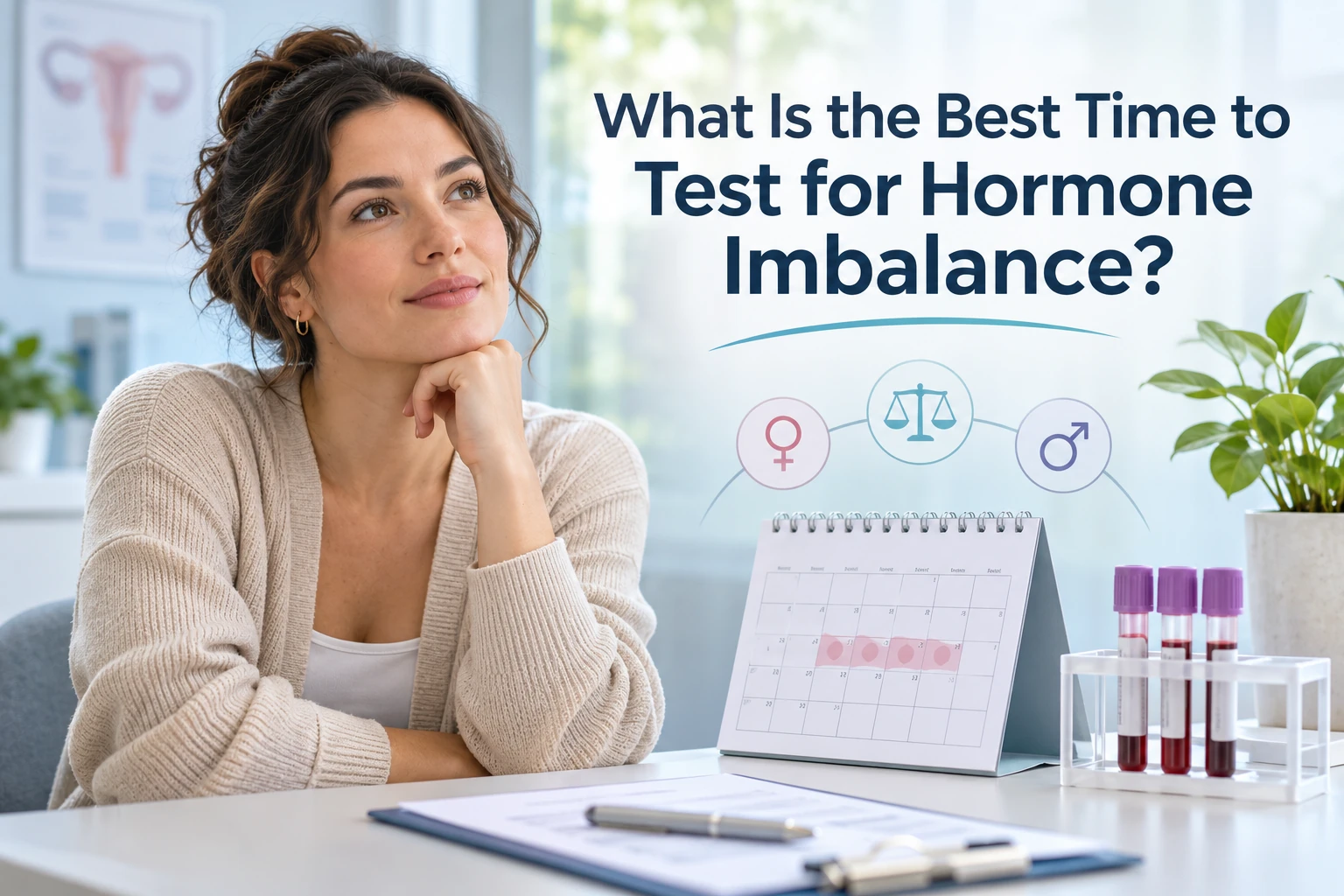
What Is the Best Time to Test for Hormone Imbalance?

The best time to test for hormone imbalance depends on which hormone you’re checking.

Testosterone and cortisol should be drawn in the morning, between 7 and 10 a.m.

Female reproductive hormones like FSH, LH, and estradiol are most accurate on cycle days 2 through 5, while progesterone needs to wait until about a week before your period.

Getting the timing wrong is one of the most common reasons a hormone panel comes back “normal” even when symptoms say otherwise.

If you’ve ever gotten a hormone panel back that said everything was fine, even though you felt exhausted, foggy, or just not like yourself, timing may be the reason.

Hormones aren’t static numbers.

They rise and fall by the hour and by the day, and a blood draw taken at the wrong moment can hide a real imbalance behind a technically normal result.

This guide breaks down exactly when to test each major hormone, why the timing matters so much, and what to do if your cycle is irregular or you’ve already gone through menopause.


GET HELP BALANCING YOUR HORMONES 


Why Timing Changes Your Hormone Test Results

Hormones follow predictable daily and monthly rhythms, and testing outside those windows can produce a result that looks normal on paper but misses what’s actually happening in your body.

Cortisol and testosterone follow a 24-hour circadian pattern, while estrogen, progesterone, FSH, and LH follow the roughly monthly rhythm of the menstrual cycle.

Cortisol is a good example of how dramatic this swing can be.

Levels peak shortly after waking and are typically drawn between 7 and 10 a.m., when they’re highest, then drop by roughly 50% by late afternoon.

A sample drawn at 4 p.m. can look low even in someone with perfectly healthy adrenal function, simply because that’s when cortisol is supposed to be lower.

The same logic applies to reproductive hormones, just on a monthly scale instead of a daily one.

Estradiol suppresses FSH, so testing FSH on the wrong cycle day can mask a problem that would show up clearly on day 3.

Timing isn’t a minor detail here.

It’s often the difference between a result your provider can actually use and one that sends you home with no answers.


What Time of Day Should You Test Testosterone and Cortisol?

Testosterone and cortisol should both be tested in the morning, ideally between 7 and 10 a.m., because that’s when circulating levels are at their daily peak.

Testing later in the day can produce results 20% to 30% lower than a morning draw, which can make a normal level look low or mask an actual deficiency.

Testosterone follows a tight circadian rhythm that peaks shortly after waking and declines steadily as the day goes on.

The Endocrine Society’s clinical practice guideline specifically recommends morning blood draws, taken between 7 and 10 a.m., to get an accurate reading.

This matters for both men being evaluated for low testosterone and women with symptoms of androgen imbalance.

Cortisol behaves the same way.

Mayo Clinic Laboratories collects morning cortisol specimens between 6 and 10:30 a.m. for this exact reason.

If you’re being evaluated for adrenal fatigue, burnout, or unexplained weight changes, an afternoon cortisol draw simply won’t give your provider the information they need.


When During Your Menstrual Cycle Should You Test Female Hormones?

Female reproductive hormones need to be tested on specific cycle days to be meaningful.

FSH, LH, and estradiol are typically drawn on cycle days 2 through 5, using the first day of full bleeding as day 1, while progesterone is tested about a week before your expected period to confirm ovulation actually happened.

Testing FSH, LH, and Estradiol (Cycle Days 2-5)

Early in the cycle, estradiol is naturally low, which lets FSH and LH show their true baseline levels without interference.

Research tracking hormone levels across the natural menstrual cycle confirms this early window is when these three hormones are most stable and easiest to interpret together.

Testing even a few days later can throw off the results, since rising estradiol starts suppressing FSH before ovulation.

A high FSH reading on day 3 is a meaningful signal about ovarian reserve.

The same number on day 10 tells you almost nothing.

Testing Progesterone (Mid-Luteal Phase)

Progesterone peaks in the mid-luteal phase, roughly five to seven days after ovulation, which lands around day 21 in a textbook 28-day cycle.

But not every cycle is 28 days, so counting backward from your next expected period is more reliable than counting forward from day 1.

Testing progesterone too early or too late in the cycle is one of the most common reasons women are told their levels are “fine” despite symptoms of low progesterone, like difficulty sleeping, anxiety before their period, or short luteal phases.

If you have symptoms of low estrogen alongside irregular cycles, both hormones often need to be evaluated together rather than in isolation.

What If Your Cycle Is Irregular or You’re Not Having Periods?

If your cycles are unpredictable or absent, cycle-day testing isn’t possible in the usual sense, so your provider will typically order a broader panel at a single visit rather than timing around ovulation.

This is common with conditions like polycystic ovary syndrome, which the CDC estimates affects a meaningful share of women between the ages of 20 and 49 in the United States.

In these cases, a single comprehensive draw, paired with symptom tracking over a few weeks, usually gives a clearer picture than chasing a specific cycle day that may never arrive on schedule.


Does Thyroid Testing Depend on Timing Too?

Thyroid testing is less sensitive to time of day than testosterone or cortisol, but morning testing is still preferred, and fasting is not required for a standard TSH test.

The bigger timing issue with thyroid testing isn’t the clock.

It’s supplements.

Biotin, a common ingredient in hair, skin, and nail supplements, can interfere with the lab equipment used to measure thyroid hormones, producing a falsely low TSH and falsely high T4 or T3.

The American Thyroid Association recommends stopping biotin supplements for at least 72 hours before a thyroid panel, longer if your dose is 10,000 micrograms or more.

Thyroid issues are also far more common than most people realize.

The same organization notes that roughly 1 in 8 women will develop a thyroid disorder in her lifetime, and as many as 60% of people with a thyroid condition don’t know they have one.


What About Testing Hormones During Perimenopause or After Menopause?

Perimenopause makes timing especially tricky, because hormone levels can swing from a “normal” reading to a clearly menopausal one within the same week.

A single FSH or estradiol draw during perimenopause often reflects that specific day more than it reflects your overall hormonal status.

This doesn’t mean testing is pointless during this stage.

It means the result needs to be interpreted alongside your symptoms, not treated as the final word on its own.

Many women going through this transition benefit from hormone support strategies that are adjusted over time as levels continue to shift, rather than from chasing one perfect lab value.

After menopause, hormone levels settle into a more consistent, low pattern, which actually makes testing more straightforward than it was during perimenopause.

At that point, timing matters less than making sure the full picture, including thyroid and adrenal function, is being looked at together.


How PRIME Medicine Approaches Hormone Testing in Orange County

Getting hormone testing right takes more than ordering a panel.

It takes knowing which hormones to test, when to schedule the draw, and how to read the result in the context of your symptoms and history.

That combination is exactly what our team at PRIME Medicine builds every treatment plan around.

Our specialty testing goes beyond a standard primary care panel, looking at the full hormonal picture rather than a single marker in isolation.

Licensed naturopathic doctors and medical doctors work together here, which means your results get reviewed from both a conventional and a functional medicine lens before any treatment is recommended.

If testing points to a genuine imbalance, we offer hormone replacement therapy for women and hormone replacement therapy for men, along with dedicated testosterone replacement therapy for men and women dealing with low androgen symptoms.

Every plan is built around your actual lab timing and results, not a generic protocol.

If you’re searching for answers in Orange County, our providers take a functional medicine approach that looks for root causes rather than just matching a lab value to a prescription.

That’s often what separates a hormone panel that actually changes how you feel from one that just confirms what you already suspected.


CONTACT US


5 Mistakes That Throw Off Your Hormone Test Results

Even with the right test ordered, a few common mistakes can quietly skew your results and lead to a misleading “normal” reading.

  • Testing at the wrong time of day: An afternoon testosterone or cortisol draw can read 20% to 30% lower than a morning sample, even in someone with healthy hormone production.
  • Not tracking your actual cycle day: Assuming ovulation happens on day 14 when your cycles run longer or shorter can push progesterone and estradiol testing off by a week or more.
  • Taking biotin supplements beforehand: High-dose biotin can distort thyroid results for days after your last dose, even if you feel fine.
  • Skipping fasting instructions: Some panels, like insulin or glucose markers often ordered alongside hormones, do require fasting, even though thyroid tests generally don’t.
  • Testing only once and stopping there: A single snapshot can miss a pattern that only shows up when levels are tracked over two or three cycles.


How to Prepare for a Hormone Test

Preparing for a hormone test means scheduling it at the right time, pausing any interfering supplements, and following your lab’s specific fasting instructions.

A little preparation goes a long way toward getting a result that actually reflects what’s happening in your body.

Book morning appointments whenever testosterone, cortisol, or thyroid markers are involved, ideally before 10 a.m.

If you’re tracking a menstrual cycle, note your start date in a calendar or app so you can count forward or backward accurately instead of guessing.

Pause biotin and other high-dose B-vitamin supplements for at least three days beforehand, and ask your provider directly whether your specific panel requires fasting, since this varies depending on which markers are included.

It also helps to write down your symptoms, and when they tend to show up, before your appointment.

A provider reading your results alongside a clear symptom timeline can catch patterns that the lab values alone won’t reveal.


How Often Should You Retest Your Hormones?

Most people being evaluated for a suspected imbalance should retest within 6 to 12 weeks of starting any treatment, then move to retesting every 3 to 6 months once levels stabilize.

Hormones that are actively being treated need closer monitoring than ones that are simply being watched.

If you’re on hormone therapy and your dose was recently adjusted, retesting sooner, rather than waiting for your next annual physical, helps confirm the new dose is actually working before months pass.

This is a common question for anyone wondering whether their current HRT dose needs to change, since symptoms alone don’t always line up neatly with lab numbers.

For anyone not yet on treatment, retesting every 6 to 12 months is usually enough, unless new symptoms show up sooner and warrant a closer look.


SCHEDULE A CONSULTATION


FAQs: What Is the Best Time to Test for Hormone Imbalance

What is the single best time of day to test hormones?

There isn’t one single best time for every hormone. Testosterone and cortisol are most accurate between 7 and 10 a.m., while female reproductive hormones depend on your menstrual cycle day rather than the clock.

Can I test my hormones if my periods are irregular?

Yes. Your provider will usually order a broader panel at a single visit instead of timing the draw to a specific cycle day, since predicting ovulation isn’t reliable with irregular cycles.

Does fasting affect hormone test results?

It depends on the panel. Standard thyroid tests generally don’t require fasting, but markers like insulin or glucose that are often ordered alongside hormone panels usually do.

Why did my hormone test come back normal even though I have symptoms?

This often happens when the test was drawn at the wrong time of day or the wrong cycle day, which can mask a real imbalance behind a technically normal number. Retesting at the correct time frequently tells a different story.

Should men get their hormones tested too?

Yes. Testosterone naturally declines with age, and morning testing between 7 and 10 a.m. gives the most accurate picture for men experiencing fatigue, low libido, or mood changes.

How soon should I retest after starting hormone therapy?

Most people retest 6 to 12 weeks after starting or adjusting treatment, then shift to every 3 to 6 months once levels have stabilized.

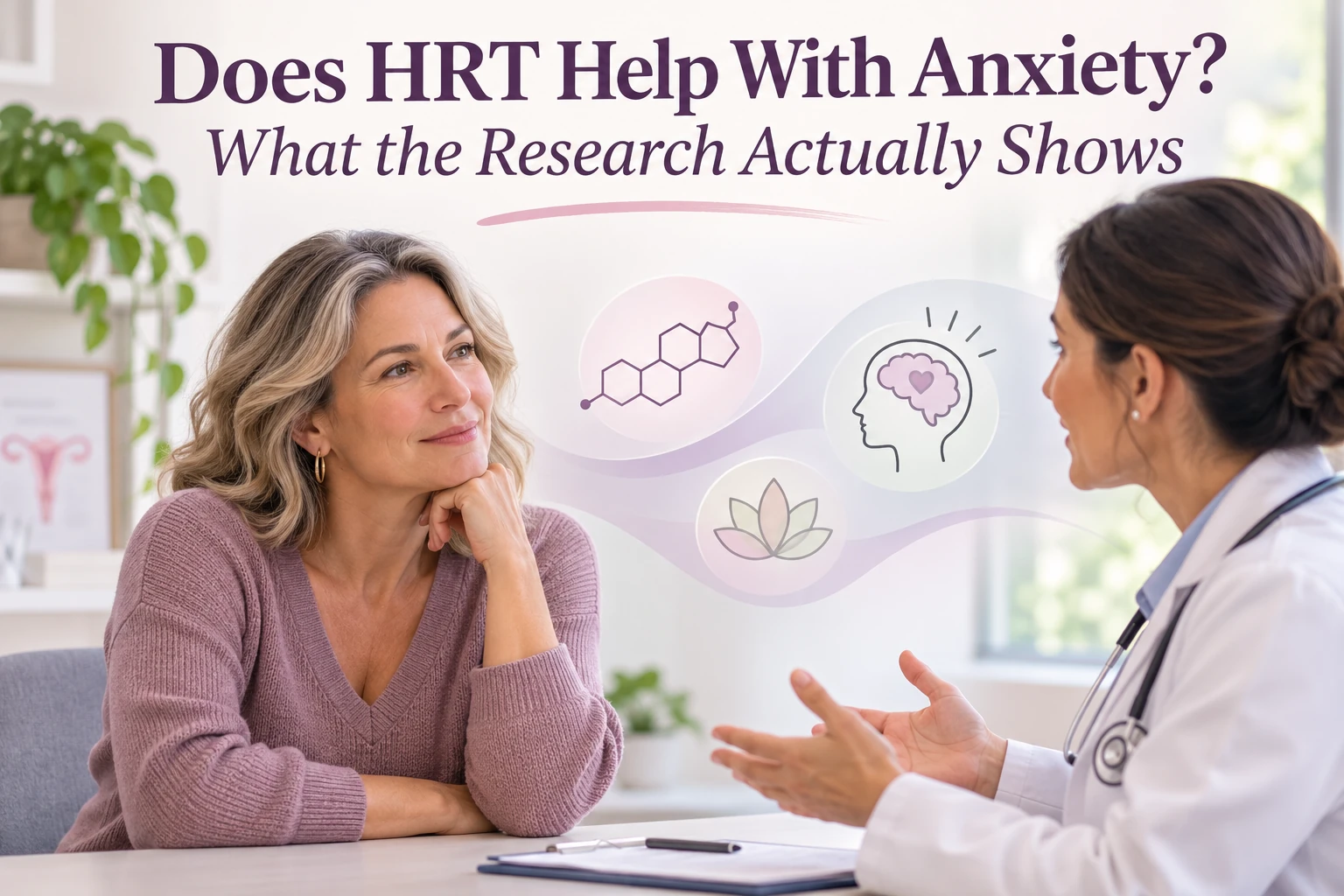
Does HRT Help With Anxiety?

HRT can ease anxiety when it’s driven by hormone swings, especially estrogen and progesterone shifts in perimenopause.

Research is mixed overall, but symptomatic women often see modest, real relief within weeks to a few months.

It works best alongside the right dose, delivery method, and a provider who checks whether your anxiety is actually hormone related.

If you’ve typed does HRT help with anxiety into a search bar at 2 a.m., you already know the feeling isn’t just in your head.

Hormone replacement therapy sits at the center of one of the most debated questions in menopause care, and for good reason.

Some studies show real relief.

Others show no difference at all.

The truth is that the answer depends on where your anxiety is coming from, which is why hormone replacement therapy for women usually starts with figuring out what’s actually driving your symptoms rather than guessing.


SEE IF HRT IS RIGHT FOR YOU


Can Hormones Really Affect Your Anxiety Levels?

Yes.

Estrogen and progesterone both act directly on the parts of your brain that control fear and calm, including serotonin activity and the amygdala.

When these hormones swing or drop sharply during perimenopause, anxiety can appear even in people who have never struggled with it before.

Estrogen helps keep serotonin, the chemical most closely tied to steady mood, running smoothly, and it also acts on the amygdala, the brain’s fear center.

Progesterone works differently.

Its breakdown products bind to GABA receptors, the same calming pathway used by anti-anxiety medication.

Somewhere between 15 and 50 percent of women going through perimenopause and menopause report real anxiety symptoms, a wide range that reflects how differently each person’s body responds to shifting hormone levels.

Researchers tracking anxiety disorders in perimenopausal women globally have found that the burden of anxiety in this group has been climbing since 1990 and could rise more than 40 percent by 2035 if current trends continue.


What Does the Research Say About HRT and Anxiety?

The honest answer is that researchers are still working this out.

A systematic review presented to The Menopause Society looked at seven studies covering more than 1,200 women directly treated with hormone therapy, plus observational data from close to 175,000 more.

The conclusion was nuanced: hormone therapy did not consistently reduce anxiety across the board, but it did show modest benefits for perimenopausal and early postmenopausal women who already had noticeable symptoms.

Oral estrogen showed the most promise in that review, though other research complicates the picture.

A separate analysis found that the effect of HRT on anxiety is less clear than its effect on hot flashes or sleep, and that hormone therapy may work better for women who went through surgical menopause than those who reached menopause naturally.

Dosage, delivery method, and how close someone is to their final period all seem to change the outcome.

That inconsistency isn’t a reason to write off HRT.

It’s a sign that anxiety during menopause has more than one cause, and hormones are only part of the story for some women.


How Does HRT Calm Anxiety Symptoms?

HRT calms anxiety mainly through two pathways.

Estrogen helps stabilize serotonin and tone down the brain’s fear response, while progesterone breaks down into compounds that bind to GABA receptors, the same calming system targeted by anti-anxiety medication.

Restoring both hormones can quiet the physical edge that drives a lot of menopausal anxiety.

Estrogen and the Fear Response

When estrogen drops unevenly, the amygdala can become more reactive, making ordinary stress feel bigger than it should.

Low estrogen rarely shows up as anxiety alone.

It tends to travel with a cluster of other symptoms of low estrogen, including hot flashes, brain fog, and disrupted sleep, each of which can make anxiety feel worse.

Progesterone and GABA Receptors

Progesterone’s main calming effect comes from allopregnanolone, a compound your body makes as progesterone breaks down.

It binds to GABA receptors in the brain, slowing down overactive nerve signals and promoting a sense of calm.

Because this same pathway also encourages drowsiness, restoring progesterone often improves sleep too, and better sleep tends to lower anxiety on its own.


How Long Does It Take HRT to Ease Anxiety?

Most people notice some easing of anxiety within a few weeks of starting HRT, though it usually takes about three months for the full effect to settle in.

How long HRT takes to work depends on your dose, your delivery method, and how closely your anxiety is tied to hormone levels in the first place.

Real-world data backs up that timeline.

One study tracking women before and after starting hormone therapy found that 62.3 percent initially scored in the severe range for mood symptoms, a number that dropped to 24.6 percent after about four and a half months of treatment.

Women with the most severe symptoms at the start saw the biggest improvements.

That study didn’t include an untreated comparison group, so it can’t prove hormone therapy alone caused the change.

Still, a drop that size is hard to ignore, especially paired with how many women report feeling calmer within the first few weeks.


Can HRT Make Anxiety Worse Before It Gets Better?

Yes, for some people.

Starting HRT can trigger a short adjustment period where anxiety temporarily spikes, especially if the dose is too high, too low, or the delivery method doesn’t suit your body.

This usually settles within a few weeks as your levels stabilize.

Common triggers include dosage imbalance, the adjustment period itself, added life stress, and poor sleep, all of which can amplify anxiety independently of whether HRT is actually helping.

That overlap is part of why the research on HRT and anxiety is so mixed.

It’s genuinely hard to separate hormone effects from everything else happening in someone’s life at the same time.

If anxiety spikes rather than eases after you start treatment, it’s often a sign of needing a higher dose or a different formulation, not a reason to stop treatment altogether.


Is Your Anxiety Actually Hormone Related?

Not all anxiety is caused by hormones, so HRT won’t resolve anxiety rooted in stress, trauma, or a standalone anxiety disorder.

The clearest sign your anxiety is hormone related is timing: it tends to rise and fall alongside your cycle changes, hot flashes, or other classic perimenopause symptoms.

Guessing based on symptoms alone only goes so far, since anxiety can look identical whether it’s hormone driven or not.

The most reliable way to know for certain is through specialty hormone testing that measures where your estrogen and progesterone actually sit, rather than relying on how you feel on any given day.


CONTACT US


What If HRT Doesn’t Fully Resolve Your Anxiety?

HRT was never meant to be a complete treatment for an anxiety disorder, and no major health authority recommends using it as one on its own.

When anxiety doesn’t improve, or only improves partially, combining hormone therapy with talk therapy, exercise, or anti-anxiety medication tends to work better than relying on any single approach.

Duration matters too.

There’s no fixed timeline for how long menopausal anxiety lasts, since it depends on your hormone trajectory, lifestyle, and mental health history.

For women who decide to stay on HRT long term, that choice is usually driven by bone health, heart health, and quality of life altogether, not mood alone.


How PRIME Medicine Approaches Hormone-Related Anxiety

At PRIME Medicine, we don’t start by assuming anxiety is hormonal, and we don’t assume it isn’t either.

We start by testing.

Our providers build hormone balancing plans around your actual lab results, not a standard dose everyone gets handed on day one.

If your anxiety is tied to shifting estrogen and progesterone, we adjust dose and delivery method until your levels, and how you feel, actually line up.

If it isn’t, we’ll tell you that too, and help you find the right next step instead of leaving you on a treatment that isn’t working.

Our team includes providers who specialize in exactly this kind of individualized hormone care, with Orange County locations designed to make ongoing monitoring easy rather than another thing to squeeze into your week.

So does HRT help with anxiety?

For many women whose anxiety is tied to hormone shifts, yes, often in a real and measurable way.

For anxiety rooted in something else, it’s only one piece of the puzzle.

PRIME Medicine can help you figure out which situation you’re actually in, so you’re not guessing with your own mental health.


SCHEDULE A CONSULTATION


FAQs: Does HRT Help With Anxiety

Does HRT help with anxiety during perimenopause specifically?

Perimenopause is when HRT tends to help anxiety the most, since this is when estrogen and progesterone swings are often the sharpest. Research shows modest benefits are more likely in perimenopausal and early postmenopausal women who already have noticeable symptoms, compared to women further past menopause.

Can HRT cause anxiety instead of helping it?

It can, usually temporarily. Starting HRT or adjusting your dose can cause a short window of increased anxiety while your body adapts, especially if the dose or delivery method isn’t quite right yet. This typically settles within a few weeks.

How long before I notice less anxiety on HRT?

Many women notice some improvement within a few weeks, though it usually takes about three months to feel the full effect. Results depend on your dose, delivery method, and how closely your anxiety is tied to hormone levels.

Is HRT alone enough to treat an anxiety disorder?

No. HRT isn’t designed or recommended as a standalone treatment for an anxiety disorder. It works best for anxiety tied to hormone changes, and often performs best alongside therapy, lifestyle changes, or medication when anxiety has other causes.

Does it matter if I take oral or transdermal HRT for anxiety?

It can. Some research suggests oral estrogen shows the most consistent benefit for anxiety, while other studies find that differences between delivery methods depend on the individual. A provider can help match the formulation to your symptoms and health history.

Will my anxiety come back if I stop HRT?

If your anxiety was closely tied to hormone levels, it can return when those levels drop again after stopping HRT. This is one reason some women choose to stay on hormone therapy long term, guided by their overall health goals rather than anxiety alone.

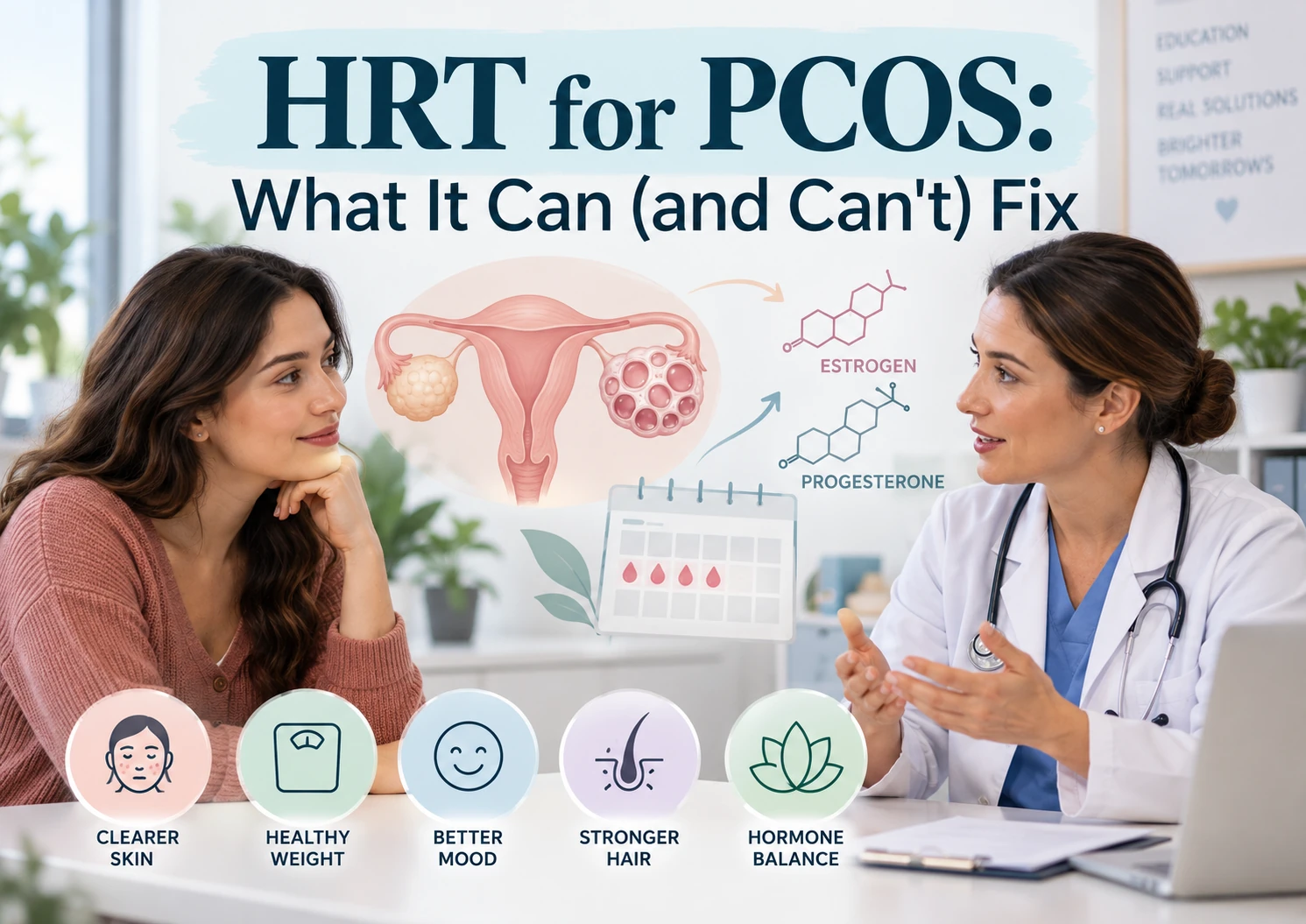
HRT for PCOS

Hormone replacement therapy can ease real PCOS symptoms like irregular cycles, low energy, and mood swings, but it works differently than birth control and isn’t the right fit for everyone.

This guide walks through what HRT actually does for PCOS, who tends to be a good candidate, what testing should come first, and where its limits are, so you know what to ask your own provider.

If you’ve read article after article about PCOS and still feel stuck between “just go on the pill” and “try these supplements,” you’re not alone.

A lot of women end up asking the same question: does hormone replacement therapy for PCOS actually work, or is it just another prescription that treats the surface?

The honest answer is that HRT for PCOS can help, but only when it’s matched to what your own labs actually show.

It isn’t a one-size-fits-all swap for birth control, and it isn’t a cure.

Here’s what it actually does, who it tends to help, and where its limits are.


SEE IF HRT IS RIGHT FOR YOU


What Is PCOS, and Why Do Hormones Get So Out of Balance?

PCOS, or polycystic ovary syndrome, is a hormonal condition where the ovaries make higher-than-typical levels of androgens, the hormones most people know as “male hormones” like testosterone.

That often happens alongside insulin resistance.

Together, those two things can stop regular ovulation, which throws off estrogen and progesterone too.

A large global analysis of PCOS prevalence found that roughly one in eight women of reproductive age meet the criteria for PCOS, with rates shifting depending on the region and which diagnostic standard is used.

Doctors look at three things when diagnosing PCOS: irregular or missing periods, higher androgen levels (shown on a blood test or as acne and extra hair growth), and ovaries with multiple small follicles on ultrasound.

You only need two of the three to be diagnosed, which is part of why PCOS can look so different from one woman to the next.

Abnormal estrogen receptor activity in the ovaries is one reason dominant follicles often fail to develop the way they should in PCOS, which is part of why ovulation becomes so irregular to begin with.

Part of the problem is that PCOS doesn’t always announce itself clearly.

Up to 70% of women with PCOS go undiagnosed for years, often because irregular periods or acne get written off as normal instead of investigated as hormone signals.


Can Hormone Replacement Therapy Help Manage PCOS?

Yes, hormone replacement therapy can help manage several PCOS symptoms, including irregular cycles, mood swings, sleep problems, and low libido, by restoring the progesterone, estrogen, and testosterone balance that PCOS disrupts.

It won’t cure PCOS or fix insulin resistance on its own, but for the right candidate, it can make day-to-day symptoms much easier to live with.

That’s a different starting point than what most women are offered first.

Standard PCOS treatment usually leans on hormonal birth control, which regulates periods and lowers androgens using synthetic estrogen and progestin.

HRT for PCOS works on a different premise.

Instead of overriding your cycle with synthetic hormones, it replaces whatever your own hormone panel shows is actually low or imbalanced.

That’s why a personalized hormone replacement therapy plan for women usually starts with lab work, not a prescription pad.

For some women, that means progesterone support to fix a short or irregular luteal phase.

For others heading into their late 30s or 40s, it might mean addressing declining estrogen on top of PCOS symptoms that never fully went away.


Why Birth Control Alone Often Falls Short for PCOS

Hormonal birth control is still considered first-line treatment for the menstrual irregularities and skin symptoms of PCOS, and it does that job well for a lot of women.

The synthetic estrogen and progestin in combination pills suppress ovulation, which regulates bleeding and lowers the androgen levels behind acne and excess hair growth.

What It Leaves Unaddressed

What the pill doesn’t do is touch insulin resistance, which drives a lot of the weight gain, fatigue, and long-term risk that come with PCOS.

Insulin resistance shows up in a large share of women with PCOS regardless of body weight, and it needs its own treatment plan, whether that’s metformin, nutrition changes, or both.

There’s also what happens when you stop.

Some women experience post-birth-control syndrome, a cluster of symptoms like irregular cycles, acne, and hair loss that shows up once the synthetic hormones that were covering for PCOS are gone.

If you’re trying to figure out whether a new hormone plan will stop your periods the way birth control does, that’s a fair question to bring to whoever manages your care, since the answer depends on the specific hormones and doses used.


SEE IF HRT IS RIGHT FOR YOU


How Is HRT for PCOS Different From Hormonal Birth Control?

Hormonal birth control uses synthetic estrogen and progestin to override your natural cycle and stop ovulation.

HRT for PCOS typically uses bioidentical hormones, most often progesterone and sometimes testosterone, dosed to correct a deficiency that shows up on your own labs.

One approach suppresses your cycle.

The other tries to correct what’s actually missing.

Bioidentical just means the hormone is molecularly identical to what your body already makes, instead of a synthetic version built to resist being broken down.

For PCOS specifically, that distinction matters because progesterone on its own can help regulate cycles and ease mood symptoms without some of the androgenic side effects that certain synthetic progestins carry.

This is also where a hormone balancing approach differs from a standard prescription: natural support comes first when it’s enough, and bioidentical HRT gets added only when testing shows it’s actually needed.


Who Is a Good Candidate for HRT With PCOS?

The best candidates for HRT with PCOS are women whose lab work shows a clear hormone deficiency, like low progesterone or declining estrogen, rather than women whose main issue is high androgens or insulin resistance alone.

Timing matters too.

What makes sense in your 20s often looks different from what makes sense heading into perimenopause.

During Your Reproductive Years

If you’re still in your reproductive years and not trying to conceive, HRT for PCOS often centers on progesterone support to shorten the gap between periods and ease PMS-like symptoms.

If you are trying to conceive, hormone therapy isn’t a substitute for ovulation induction, where letrozole is generally preferred over clomiphene for better pregnancy outcomes.

Heading Into Perimenopause

PCOS doesn’t disappear once you hit your late 30s or 40s.

It often overlaps with early perimenopause, so symptoms like hot flashes, brain fog, and sleep trouble can stack on top of whatever PCOS was already causing.

If that overlap sounds familiar, it’s worth reading through the symptoms of low estrogen to see how much of what you’re feeling might be a separate, treatable piece of the puzzle.


What Does Hormone Testing for PCOS Involve?

Hormone testing for PCOS typically checks androgens like testosterone and DHEA-S, along with estrogen, progesterone, and markers of insulin resistance such as fasting insulin and glucose.

Looking at all of these together shows which hormones are actually out of range, so treatment can target the real cause instead of following a generic protocol.

The 2023 international guideline for assessing and managing PCOS pushed for exactly this kind of broader workup instead of diagnosing PCOS on symptoms alone and prescribing the same pill to everyone.

That’s the thinking behind specialty testing that maps out your full hormone and metabolic picture before any treatment plan gets built, rather than guessing based on symptoms alone.


Risks, Limitations, and What HRT Won’t Fix

HRT for PCOS has real limits.

It won’t lower your long-term risk for the health issues PCOS is linked to on its own.

Women with PCOS carry a two to threefold higher risk of prediabetes and type 2 diabetes, a nearly fourfold higher risk of sleep apnea, and more than double the risk of depression and anxiety compared to women without it.

None of that improves just by adding progesterone or estrogen.

Insulin resistance usually needs its own plan, whether that’s medical weight loss support, metformin, or changes in how you eat.

A tailored nutrition approach built around PCOS-related insulin resistance tends to move the needle more than hormone therapy alone ever will.

HRT also isn’t something to start without lab work and ongoing monitoring.

Dosing too much or too little, or using the wrong hormone for what’s actually imbalanced, can make symptoms worse instead of better.

This is a plan to build with a provider, not something to piece together from forum posts and guesswork.


How PRIME Medicine Approaches HRT for PCOS

At PRIME Medicine, PCOS never gets treated with a single, generic prescription.

Our naturopathic doctors start with full hormone and metabolic testing, then build a plan around what your results actually show, whether that means bioidentical HRT, insulin support, nutrition changes, or some combination of all three.

This is the same functional medicine thinking we apply across every condition we treat: find what’s actually driving the symptoms before deciding how to treat them.

For PCOS, that usually means looking at your androgens, insulin, and reproductive hormones side by side instead of in isolation.

If you’re in Orange County and tired of being handed the same prescription everyone with PCOS gets, our team of naturopathic providers can walk through your labs with you and explain exactly what a hormone therapy plan built for your specific case would look like.


SCHEDULE A CONSULTATION


FAQs: HRT for PCOS

Can HRT replace birth control for PCOS?

Sometimes, but not automatically. If your main symptoms come from low progesterone or declining estrogen, HRT can address that directly instead of suppressing your cycle the way birth control does. If your main issue is high androgens or insulin resistance, birth control or other medications may still play a role alongside hormone therapy.

Is bioidentical HRT safer than the pill for PCOS?

Bioidentical hormones aren’t automatically safer, but they work differently. Because they’re dosed to match what’s actually low on your labs rather than given as a fixed synthetic dose, many women tolerate them with fewer androgenic side effects. Safety still depends on getting the right diagnosis, the right dose, and regular monitoring.

Does HRT help with PCOS weight gain?

HRT can ease symptoms like fatigue and poor sleep that make weight management harder, but it doesn’t directly fix the insulin resistance that drives most PCOS-related weight gain. Pairing hormone therapy with a nutrition plan built around insulin resistance typically works better than either approach alone.

Can you get HRT for PCOS in your 20s and 30s?

Yes. Age isn’t the deciding factor, your hormone levels are. Many women in their 20s and 30s with PCOS have low progesterone from irregular ovulation, which can be addressed with hormone therapy regardless of how far they are from menopause.

What tests are done before starting HRT for PCOS?

A full workup typically checks androgens like testosterone and DHEA-S, along with estrogen, progesterone, and insulin resistance markers like fasting insulin and glucose. Some providers also check thyroid function, since thyroid issues can mimic or worsen PCOS symptoms.

How long does it take for HRT to improve PCOS symptoms?

Most women notice changes in energy, mood, or sleep within a few weeks, while cycle regularity can take a couple of months to settle. You can read more about how long hormone therapy takes to work for a fuller breakdown of what to expect at each stage.