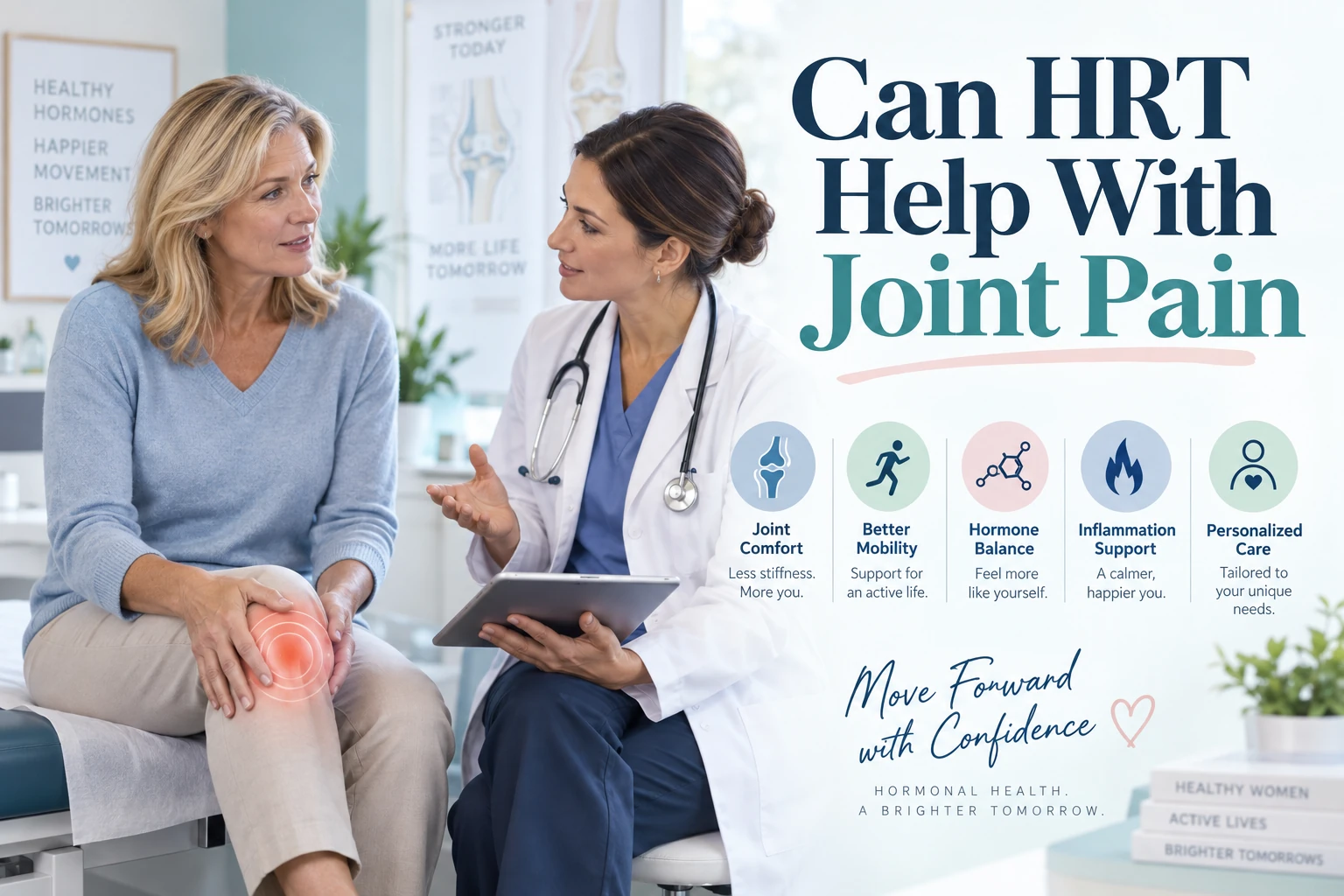
Hormone replacement therapy can meaningfully ease joint pain tied to menopause for many women, since estrogen loss drives inflammation and cartilage breakdown.
Research shows modest but real relief, especially within the first year of treatment.
It works best alongside movement and anti-inflammatory habits, and it isn’t the right fit for every joint pain case.
A personalized evaluation is the only way to know for sure.
You wake up and your knees feel like they belong to someone twenty years older.
Your hands ache when you try to open a jar, and your shoulders feel stiff before you’ve even gotten out of bed.
If this started sometime around perimenopause or menopause, you’re not imagining the connection.
A lot of women ask the same question once the aches show up: can HRT help with joint pain?
The short answer is yes, for many women, though the reasons why take a little explaining.
Can HRT Help With Joint Pain?
For many women, hormone replacement therapy can reduce joint pain linked to menopause.
Estrogen has anti-inflammatory effects and helps protect cartilage, so restoring estrogen levels through HRT often eases the stiffness and aching that shows up as hormone levels drop.
The relief tends to be real but modest, not a guaranteed cure.
This isn’t a fringe theory.
Multiple clinical studies have found that women taking estrogen report less joint pain than women taking a placebo, and the effect tends to hold up over several years of use.
That said, HRT isn’t marketed or approved specifically as a joint pain treatment.
It’s approved for menopause symptoms like hot flashes and vaginal dryness, and joint pain relief often shows up as a welcome side effect of restoring hormone balance.
That distinction matters when you’re deciding whether it’s the right treatment for your specific pain.
Why Does Menopause Cause Joint Pain in the First Place?
Joints have estrogen receptors, and estrogen normally helps calm inflammation, keep cartilage healthy, and regulate how pain signals travel through the body.
When estrogen drops sharply during perimenopause and menopause, joints can become inflamed, stiffer, and more sensitive to pain, a pattern doctors now sometimes call the musculoskeletal syndrome of menopause.
Estrogen doesn’t just affect your reproductive system.
It plays a role in bone density, muscle mass, tendons, and the cartilage that cushions your joints.
When your ovaries slow down hormone production, that protective effect fades too.
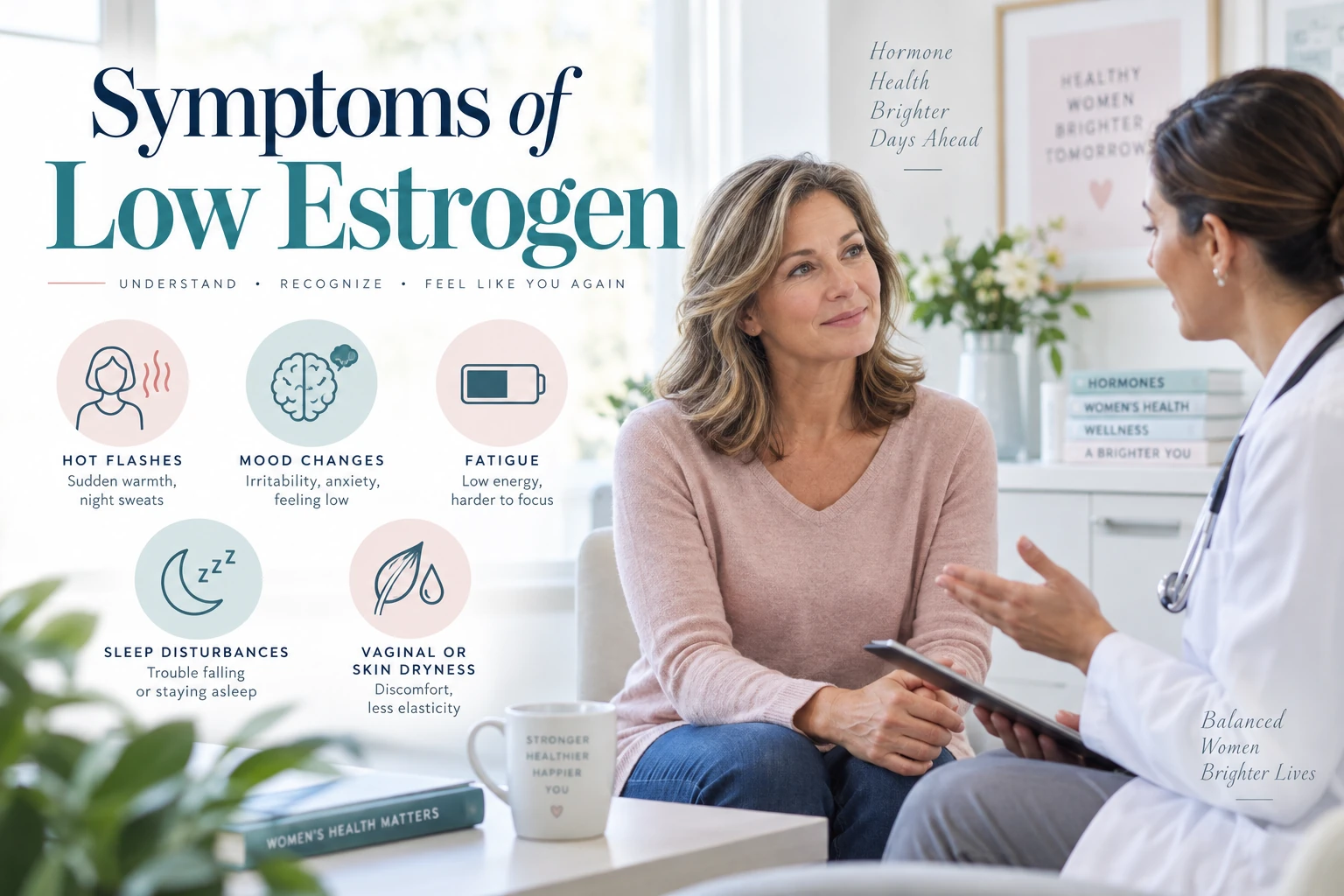
Some women notice this shift alongside other signs of hormonal change, like hot flashes or sleep trouble.
For others, joint pain is one of the first low estrogen symptoms they notice, showing up before anything else feels different.
Researchers now describe this broader pattern as the musculoskeletal syndrome of menopause, which includes joint pain, muscle aches, and a higher risk of frozen shoulder during the transition.
What Does the Research Actually Show?
The connection between estrogen and joint pain isn’t just theoretical.
Several studies have looked at what actually happens when women take hormone therapy.
The Estrogen-Joint Pain Studies
One of the largest trials followed over 10,000 postmenopausal women for more than seven years.
Women taking estrogen-only therapy reported significantly less joint pain than women taking a placebo, and the difference held steady for at least three years of treatment.
Pain severity scores were consistently lower in the estrogen group too.
Early results supported the idea that estrogen-based treatment is worth studying further as a targeted option for hand OA.
Where the Evidence Is Still Limited
Not every finding is clean.
Researchers at Duke University, cited by the Arthritis Foundation, point out that women develop osteoarthritis more often and more severely than men after age 50, and hormone therapy shows promise for slowing bone loss.
But solid research specifically on HRT and osteoarthritis pain is still thin, and experts are calling for more targeted studies rather than treating the connection as fully settled.
In plain terms, the research supports HRT as a reasonable option to discuss for joint pain, not a proven cure that works the same way for every woman.
How Long Does It Take to Feel Relief?
Most women who notice joint pain improvement from HRT see changes within three to six months of starting treatment, with continued improvement over the first year.
Relief isn’t usually instant, and some women need a dose or delivery method adjustment before they feel a real difference.
Hormone levels don’t shift overnight, and neither does inflammation that’s built up over months or years.
It’s worth giving any new HRT regimen a few full cycles before deciding whether it’s working for your joints specifically.
Duration matters too.
Many women wonder how long they can safely stay on HRT if it’s helping their joint pain, and the honest answer is that it depends on your individual health profile, not a fixed cutoff age.
That’s a conversation worth having with a provider who reviews your case regularly rather than applying a blanket rule.
Which Type of HRT Works Best for Joint Pain?
No single form of HRT has been proven best for joint pain specifically.
Options include pellets, patches, creams, gels, and injections, and each delivers estrogen a little differently.
Transdermal methods like patches and gels tend to keep hormone levels steadier than oral pills, which may matter for consistent symptom relief.
The right delivery method usually comes down to your lifestyle, other health factors, and how your body responds, not a single best answer that applies to everyone.
Some women prefer the convenience of a pellet that lasts several months.
Others do better with a patch or cream they can adjust more easily.
This is where bioidentical hormone replacement therapy comes in.
Bioidentical hormones are structurally identical to the ones your body makes naturally, and providers can combine estrogen with progesterone or testosterone depending on your full symptom picture, joint pain included.
Is HRT Right for Everyone With Joint Pain?
HRT isn’t the right choice for every woman with joint pain.
Women with a history of certain cancers, blood clots, or liver disease usually need to avoid or carefully weigh hormone therapy.
Joint pain can also come from osteoarthritis, autoimmune disease, or an old injury that has nothing to do with hormones, so it’s worth ruling out other causes first.
If your joint pain is severe, one-sided, or comes with swelling, redness, or warmth, that’s worth a medical evaluation regardless of your hormone status.
Those symptoms can point to inflammatory arthritis or another condition that needs its own treatment plan.
A thorough history and, when appropriate, bloodwork or imaging can help sort out how much of your joint pain is hormone-related and how much has a different cause.
That distinction changes what treatment actually makes sense.
Beyond Hormones: Supporting Your Joints During Menopause
HRT tends to work best as one part of a broader approach, not a stand-alone fix.
Strength training and low-impact movement, like walking, swimming, or cycling, help keep the muscles around your joints strong, which takes pressure off the joint itself.
Even short daily sessions add up over time.
An anti-inflammatory eating pattern, built around vegetables, fatty fish, and healthy fats, can support the same processes HRT targets.
Good sleep and stress management matter more than people expect too.
Poor sleep and chronic stress both raise inflammation markers in the body, which can make joint pain feel worse regardless of your hormone levels.
How PRIME Medicine Approaches Joint Pain and Hormone Health
At PRIME Medicine, we don’t start with a prescription pad.
We start with a full picture of your hormone levels, symptoms, and health history, because the answer to whether HRT will help your joint pain really does depend on your specific situation.
For women in Corona Del Mar and across Orange County, that often starts with bioidentical hormone replacement therapy tailored to your body’s needs, using pellets, patches, creams, or injections depending on what fits your life.
If joint pain persists even after your hormones are balanced, we also offer ozone injections and PRP therapy to target the joint directly and support tissue repair.
For pain that needs a more targeted or non-hormonal approach, our peptide therapy and prolotherapy options work alongside your hormone plan rather than replacing it.
The goal isn’t to sell you a single treatment.
It’s to build a plan around what’s actually driving your pain.
If joint pain has become part of your daily routine, it doesn’t have to stay that way.
PRIME Medicine can help you find out whether hormone therapy, joint-targeted treatment, or a combination of both makes sense for you.
FAQs: Can HRT Help With Joint Pain
Can HRT help with joint pain?
For many women, yes. Estrogen has anti-inflammatory effects and helps protect cartilage, so restoring hormone levels through HRT often reduces the joint pain and stiffness that develops during menopause. The relief tends to be real but modest, and results vary from person to person.
How long does it take for HRT to help joint pain?
Most women notice changes within three to six months of starting HRT, with continued improvement over the first year. Relief isn’t usually immediate, so it’s worth giving a new regimen time before deciding whether it’s working.
What type of HRT is best for joint pain?
No single delivery method has been proven best for joint pain specifically. Pellets, patches, creams, gels, and injections all deliver estrogen differently, and transdermal options like patches often keep hormone levels steadier than oral pills.
Does joint pain come back if you stop HRT?
It can. Since HRT works by restoring estrogen levels, joint pain related to low estrogen may return once hormone levels drop again after stopping treatment. This varies by individual, which is why ongoing monitoring matters.
Can HRT help with joint pain if I don’t have other menopause symptoms?
Yes, joint pain can be one of the first signs of declining estrogen, sometimes appearing before hot flashes or other common symptoms. A hormone evaluation can help determine whether low estrogen is contributing to your joint pain even without other symptoms.
What if HRT doesn’t fully relieve my joint pain?
If joint pain persists after starting HRT, it may involve other factors like osteoarthritis, an old injury, or inflammation that needs direct treatment. Combining hormone therapy with joint-targeted options, like PRP or ozone injections, often provides more complete relief.