
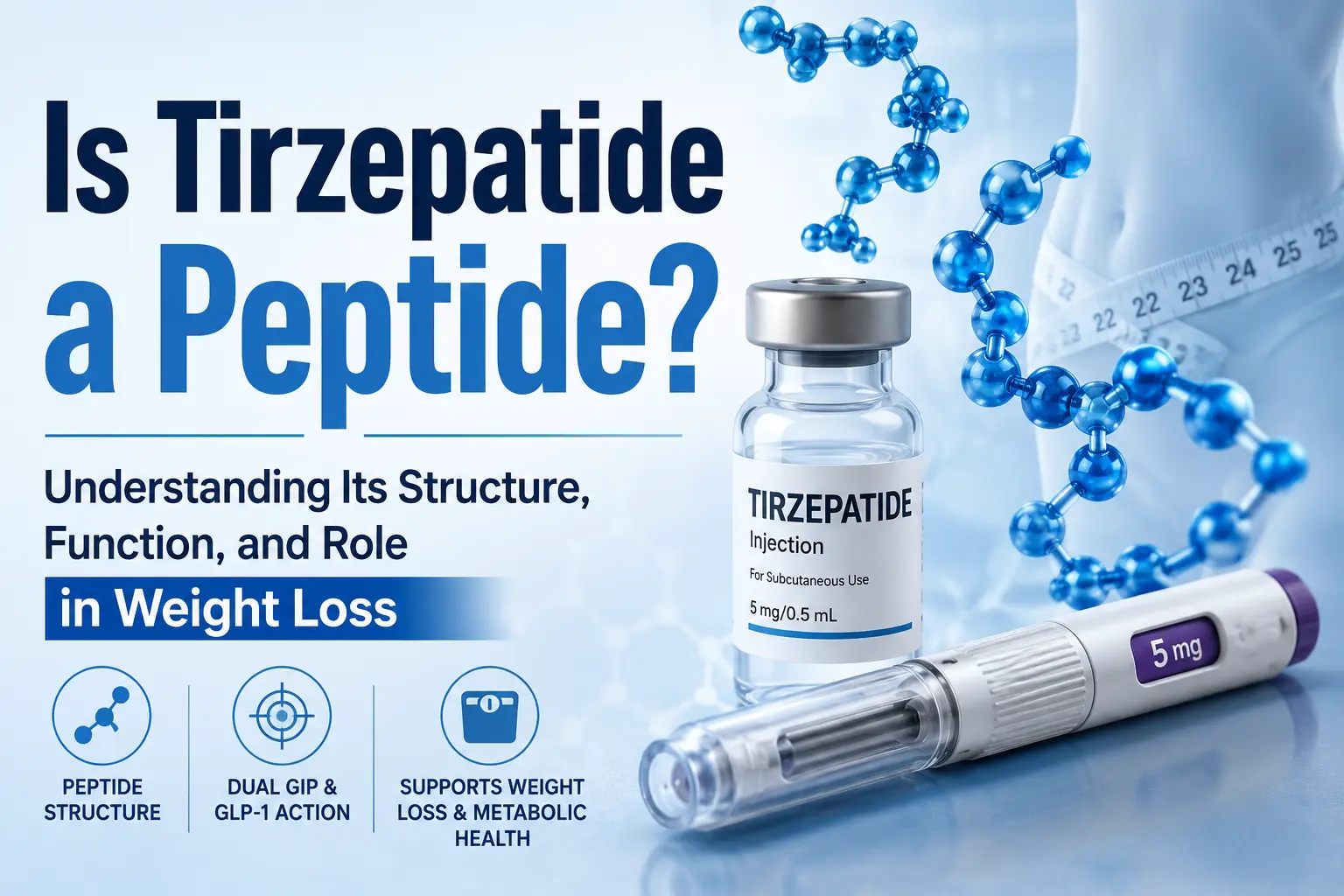
Featured image showing a tirzepatide injection pen and medication vial beside a blue molecular peptide structure. A measuring tape wrapped around a person's waist appears in the background, representing weight loss and metabolic health. Overlaid text reads: "Is Tirzepatide a Peptide? Understanding Its Structure, Function, and Role in Weight Loss".

Is Tirzepatide a Peptide?

If you’ve been researching weight loss treatments, metabolic health, or peptide therapy, you’ve probably come across the question: Is tirzepatide a peptide?

The answer is yes.

Tirzepatide is a synthetic peptide medication made from a chain of amino acids that mimics naturally occurring hormones involved in appetite regulation, blood sugar control, and metabolism.

While tirzepatide is widely known for supporting weight loss and metabolic health, many people don’t realize that its effectiveness is directly related to its peptide structure.

Understanding what a peptide is and how tirzepatide works can help clarify why this medication has become such an important advancement in metabolic medicine.

In this guide, you’ll learn what peptides are, why tirzepatide is classified as a peptide, how it works in the body, and how it compares to other peptide therapies and weight loss medications.


SEE HOW TIRZEPATIDE CAN HELP YOUR WEIGHT LOSS JOURNEY


Is Tirzepatide a Peptide? The Short Answer

Yes, tirzepatide is a peptide.

Tirzepatide is a synthetic peptide composed of 39 amino acids.

It was specifically designed to mimic the actions of naturally occurring hormones that help regulate appetite, insulin secretion, blood sugar levels, and energy balance.

Because it is made from amino acids linked together by peptide bonds, tirzepatide meets the scientific definition of a peptide.

Its structure allows it to interact with specific receptors involved in metabolic health and weight regulation.


What Is Tirzepatide?

Tirzepatide is a medication that belongs to a class of drugs known as dual GIP and GLP-1 receptor agonists.

Unlike traditional GLP-1 medications that activate a single hormone pathway, tirzepatide works by targeting two important metabolic hormones:

  • Glucose-dependent insulinotropic polypeptide (GIP)
  • Glucagon-like peptide-1 (GLP-1)

These hormones play a role in:

  • Appetite control
  • Hunger signaling
  • Blood sugar regulation
  • Insulin production
  • Energy utilization
  • Metabolic function

By activating both pathways, tirzepatide helps support a more comprehensive metabolic response than medications that target GLP-1 receptors alone.


What Is a Peptide?

Peptides are short chains of amino acids linked together by peptide bonds.

Amino acids are often called the building blocks of proteins.

The primary difference between peptides and proteins is their size.

Peptides contain fewer amino acids, while proteins are generally larger and more complex.

Peptides naturally occur throughout the body and act as signaling molecules that help cells communicate with one another.

They regulate countless biological processes, including:

  • Metabolism
  • Growth
  • Tissue repair
  • Hormone production
  • Appetite regulation
  • Immune function

Many hormones are peptides, including:

  • Insulin
  • Glucagon
  • Oxytocin
  • GLP-1
  • Growth hormone-releasing hormones

Because peptides can target specific receptors and pathways, researchers frequently use them to develop therapies designed to support particular physiological functions.


Why Is Tirzepatide Considered a Peptide?

Tirzepatide is classified as a peptide because of both its structure and function.

Structurally, tirzepatide consists of a sequence of 39 amino acids connected through peptide bonds.

Functionally, it behaves like naturally occurring peptide hormones by interacting with receptors that regulate metabolism, appetite, and insulin secretion.

Unlike many traditional medications that are synthesized from small chemical compounds, peptide medications are designed to mimic biological messengers already found within the body.

This peptide-based design allows tirzepatide to communicate with specific receptors and trigger targeted metabolic responses.


How Tirzepatide Works in the Body

The effectiveness of tirzepatide comes from its ability to activate two hormone pathways involved in metabolic regulation.

GLP-1 Receptor Activity

GLP-1 is a hormone released by the digestive system after eating.

When GLP-1 receptors are activated, the body may:

  • Feel fuller sooner
  • Stay satisfied longer
  • Slow stomach emptying
  • Improve insulin secretion
  • Reduce appetite

These effects can help decrease calorie intake and support blood sugar management.

GIP Receptor Activity

Tirzepatide also activates receptors for glucose-dependent insulinotropic polypeptide, commonly known as GIP.

GIP plays a role in:

  • Glucose metabolism
  • Insulin release
  • Energy utilization
  • Nutrient processing

Researchers believe the addition of GIP activity may contribute to the enhanced metabolic effects seen with tirzepatide.

Why Dual Receptor Activation Matters

Most medications in this category activate only GLP-1 receptors.

Tirzepatide’s dual-action mechanism allows it to engage both GIP and GLP-1 receptors simultaneously.

This broader approach helps influence multiple pathways involved in hunger, satiety, insulin response, and overall metabolic function.


Is Tirzepatide a GLP-1 Peptide?

Not exactly.

Tirzepatide does activate GLP-1 receptors, but it is not considered a traditional GLP-1 receptor agonist because it also activates GIP receptors.

This distinction is important because tirzepatide works through two complementary hormone pathways instead of one.

For that reason, many experts classify tirzepatide as a dual GIP and GLP-1 receptor agonist rather than simply a GLP-1 medication.


Tirzepatide Peptide Structure Explained

One of the reasons tirzepatide has attracted so much attention is its sophisticated peptide design.

Scientists engineered tirzepatide to mimic naturally occurring incretin hormones while remaining active in the body for extended periods.

Its molecular structure includes modifications that help:

  • Increase stability
  • Extend half-life
  • Resist rapid breakdown
  • Support once-weekly administration
  • Maintain receptor activity between doses

Without these structural modifications, the peptide would be cleared from the body much more quickly and require significantly more frequent dosing.

This engineered design is one of the key reasons tirzepatide can provide sustained metabolic effects throughout the week.


Is Tirzepatide Considered Peptide Therapy?

Many patients searching for tirzepatide also wonder whether it falls under the category of peptide therapy.

Technically, the answer is yes.

Because tirzepatide is a peptide-based medication, many healthcare providers include it within broader discussions about peptide therapy.

However, peptide therapy is a broad term that can include many different compounds with different purposes.

Some peptide therapies focus on:

  • Recovery and healing
  • Growth hormone support
  • Muscle development
  • Hormone optimization
  • Anti-aging strategies

Tirzepatide is unique because it primarily focuses on metabolic health, appetite regulation, and weight management.


How Tirzepatide Differs From Other Peptides

Not all peptides work the same way.

Different peptides target different biological systems and produce different effects.

Although these compounds are all peptides, they are designed to influence very different biological processes.


Tirzepatide vs Semaglutide

Tirzepatide and semaglutide are often compared because both are peptide-based medications used to support weight management and metabolic health.

However, they work differently.

Tirzepatide

  • Activates both GIP and GLP-1 receptors
  • Targets two metabolic pathways
  • Supports appetite regulation and metabolic function
  • Classified as a dual receptor agonist

Semaglutide

  • Activates GLP-1 receptors only
  • Targets a single metabolic pathway
  • Supports appetite regulation and blood sugar control
  • Classified as a GLP-1 receptor agonist

Both medications are peptides, but tirzepatide’s dual-receptor activity makes its mechanism of action distinct.


Why Are Peptides Used for Weight Loss?

Many people searching for weight loss peptides are surprised to learn that hormones involved in hunger and metabolism are naturally occurring peptides.

Researchers often develop peptide-based medications because peptides can interact with highly specific receptors throughout the body.

In the case of tirzepatide, its peptide structure allows it to communicate directly with pathways involved in:

  • Appetite control
  • Satiety signaling
  • Insulin response
  • Glucose regulation
  • Energy metabolism

This targeted activity is one reason peptide-based therapies have become increasingly important in the field of metabolic medicine.


Benefits of Tirzepatide’s Peptide Structure

The peptide design of tirzepatide offers several unique advantages.

Targeted Receptor Activity

Peptides can be engineered to interact with specific receptors, allowing for highly targeted biological effects.

Biological Compatibility

Because peptides mimic naturally occurring hormones, they work alongside existing physiological pathways.

Longer Duration of Action

Structural modifications help tirzepatide remain active for extended periods, supporting convenient once-weekly dosing.

Dual Hormone Support

Its unique peptide structure allows it to activate both GIP and GLP-1 receptors simultaneously.

Metabolic Regulation

The combination of targeted receptor activity and prolonged action helps support appetite regulation and metabolic health.


Who May Be a Candidate for Tirzepatide?

Tirzepatide may be appropriate for adults seeking medical support for weight management or metabolic health concerns.

A healthcare provider can evaluate factors such as:

  • Current health status
  • Medical history
  • Weight loss goals
  • Existing medications
  • Metabolic conditions

The best treatment approach will depend on an individual’s specific health needs and goals.


SEE IF TIRZEPATIDE IS RIGHT FOR YOU


Final Thoughts: Is Tirzepatide a Peptide

So, is tirzepatide a peptide?

Yes.

Tirzepatide is a synthetic peptide composed of 39 amino acids that was engineered to mimic naturally occurring hormones involved in metabolism, appetite regulation, and blood sugar control.

Its peptide structure enables it to activate both GIP and GLP-1 receptors, making it different from traditional GLP-1 medications and many other peptide therapies.

Whether you’re researching peptide therapy for weight loss, or learning more about metabolic health, understanding that tirzepatide is a peptide helps explain how it works and why it has become such an important tool in modern metabolic medicine.


SCHEDULE A CONSULTATION


FAQs: Is Tirzepatide a Peptide

Is tirzepatide considered a peptide?

Yes, tirzepatide is considered a peptide because it is made from a chain of 39 amino acids linked together by peptide bonds. Its structure allows it to mimic naturally occurring hormones involved in metabolism, appetite regulation, and blood sugar control.

What type of peptide is tirzepatide?

Tirzepatide is a synthetic peptide and a dual GIP and GLP-1 receptor agonist. It was engineered to activate two hormone pathways that help regulate hunger, insulin release, and metabolic function.

Is tirzepatide a GLP-1 peptide?

Tirzepatide acts on GLP-1 receptors, but it is not solely a GLP-1 peptide. Unlike traditional GLP-1 medications, tirzepatide also activates GIP receptors, giving it a dual-action mechanism.

Why is tirzepatide called a peptide?

Tirzepatide is called a peptide because it consists of amino acids connected by peptide bonds. This structure fits the scientific definition of a peptide and enables it to function similarly to naturally occurring peptide hormones.

How does tirzepatide help with weight loss?

Tirzepatide helps regulate appetite and feelings of fullness by activating GIP and GLP-1 receptors. These effects can help reduce calorie intake and support healthy weight management when combined with lifestyle changes.

What is the difference between tirzepatide and semaglutide?

Both tirzepatide and semaglutide are peptide-based medications, but tirzepatide activates both GIP and GLP-1 receptors, while semaglutide targets only GLP-1 receptors. This difference gives tirzepatide a unique mechanism of action.

Are all weight loss peptides the same?

No. Weight loss peptides can work through different pathways in the body. Some target appetite regulation and metabolism, while others focus on growth hormone production, recovery, or body composition. Tirzepatide specifically targets GIP and GLP-1 receptors to support metabolic health and weight management.

Can tirzepatide be used for metabolic health?

Yes, tirzepatide was designed to support metabolic health by helping regulate blood sugar levels, insulin response, appetite, and energy balance. A healthcare provider can determine whether it may be appropriate based on an individual’s health goals and medical history.
Share the Post:

Facebook
Twitter
LinkedIn
X

Leave a Reply

Your email address will not be published. Required fields are marked *

Related Posts

HRT and Migraines

Migraines often change during perimenopause and menopause because of shifting estrogen levels, and hormone replacement therapy can go either way: it helps some women and makes things harder for others.

Steady, low dose transdermal options tend to work better than pills, and migraine with aura calls for extra care rather than automatic disqualification.

Most women need a few months and some fine tuning with their provider to find the right fit.

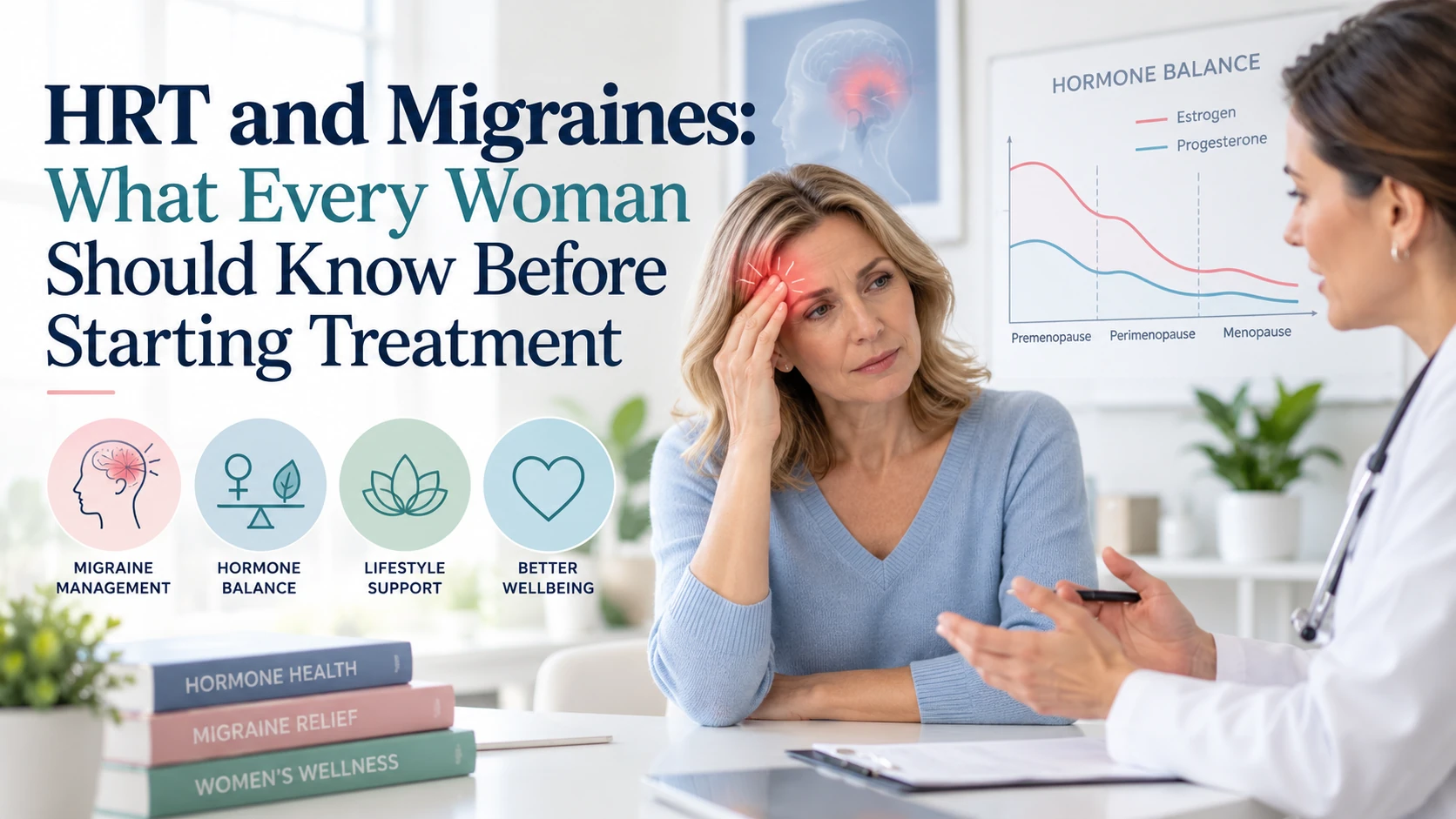
If your migraines have gotten worse, or started showing up for the first time, since you hit your 40s, you are not imagining it.

Shifting estrogen levels during perimenopause and menopause are one of the most common reasons migraines change.

That is exactly why so many women start researching hrt and migraines in the same search.

Hormone replacement therapy can genuinely help some women get their migraines under control.

For others, the wrong type or dose makes attacks worse.

The difference usually comes down to how HRT is dosed and delivered, not whether you have migraines in the first place.


SEE IF HRT IS RIGHT FOR YOU


Can HRT Help With Migraines?

Yes, for many women HRT can reduce how often migraines happen and how severe they feel, as long as the estrogen dose stays low and steady.

Formulations delivered through a patch, gel, or spray tend to work better than pills, because they avoid the sharp hormone swings that can trigger an attack.

Having a history of migraine does not automatically rule out hormone replacement therapy for women.

The Migraine Trust notes that migraine itself is not a reason to avoid HRT, though the type of hormone therapy and how it is delivered both matter more than most women expect.

Some women notice fewer attacks within the first few weeks.

Others need a dose adjustment or a switch in delivery method before they feel a real difference.

This is normal, and it is one of the reasons migraine history is worth bringing up at the very first HRT consultation, not after treatment has already started.


Why Do Hormones Affect Migraines in the First Place?

Estrogen affects the blood vessels and brain chemicals involved in triggering a migraine attack.

When estrogen drops suddenly, whether that happens right before your period, during perimenopause, or after stopping birth control, your brain can respond with a migraine.

This is why attacks often get worse exactly when hormone levels are the most unpredictable.

The Estrogen Withdrawal Trigger

Researchers call this the estrogen withdrawal hypothesis.

A 2023 review of hormonal migraine research explains that a sharp drop in estradiol late in the menstrual cycle is what triggers many menstrual migraines, not low estrogen on its own.

The same mechanism explains why the hormone swings of perimenopause can trigger new or worsening migraine.

Migraine already affects women at much higher rates than men.

The same review points out that migraine affects roughly 15% of people worldwide and occurs about three times more often in women, largely because of these hormone-driven triggers.

The World Health Organization ranks migraine as the second leading cause of disability globally, and women under 50 carry a disproportionate share of that burden.

Why Perimenopause Makes Migraines Worse

Perimenopause is often rockier than menopause itself for migraine sufferers.

During this stage, estrogen does not decline steadily.

It swings up and down unpredictably for months or years before settling.

The Migraine Trust describes these hormone fluctuations as the main reason migraine frequency and severity tend to increase during perimenopause, even in women who had mild or infrequent attacks before.

Once your symptoms of low estrogen settle into a consistent post-menopausal pattern, many women find their migraines ease up again, often within a year or two.

That timeline varies quite a bit from person to person, which is part of why an individualized plan matters more than a generic one.


Is HRT Safe If You Have Migraine With Aura?

Migraine with aura calls for a careful, individualized look at your stroke risk before starting HRT, but it does not automatically rule hormone therapy out.

Non-oral forms like patches and gels use far lower estrogen doses than birth control pills and skip the liver processing that raises clotting risk, which is why many women with aura can still be candidates under the right medical supervision.

The concern itself is real and worth taking seriously.

The American Heart Association journal Stroke has published research showing migraine with aura carries roughly three times the baseline risk of ischemic stroke, and that risk climbs further with smoking or high-estrogen birth control.

The same research base shows absolute risk stays low for most women, and it rises mainly when aura is combined with other risk factors like smoking or high-dose estrogen contraceptives.

Menopausal hormone therapy is not the same as birth control, and the dosing difference matters.

One clinical review found that stroke risk for women with migraine with aura rose from a baseline of about 5.9 per 100,000 to 36.9 per 100,000 with hormonal contraceptive use, a jump driven by the much higher estrogen doses used in combined birth control pills.

HRT doses used for menopause management sit well below that range, which is one reason non-oral HRT is treated differently from contraceptive pills in clinical guidance.

None of this means aura should be ignored.

It means aura calls for a conversation about your personal risk factors, smoking status, and family history, and a delivery method chosen with that risk profile in mind, rather than a blanket no.


Which Type of HRT Is Best for Migraine Sufferers?

Let’s take a look at which type of HRT may work best for you:

Patches, Gels, and Sprays vs. Pills

Transdermal patch, gel, or pill options are not interchangeable when migraine is part of the picture.

The National Migraine Centre recommends starting with low transdermal doses, sometimes as little as one oestrogen patch or a single pump of gel, because these routes keep hormone levels far steadier than a daily tablet.

Oral tablets are processed through the liver and tend to create more peaks and valleys in blood hormone levels over the course of a day.

For most people that difference is minor.

For someone whose migraines are triggered by hormone swings, it can be the difference between a treatment that helps and one that backfires.

Why Dose and Consistency Matter

Consistency, not just dose size, is what tends to calm migraine-prone brains.

A clinical trial of transdermal estradiol reviewed in the hormonal migraine literature found a 22% reduction in migraine days among women using steady-dose patches compared to placebo, while results with oral estrogen were far less consistent.

If your current regimen feels like it is sliding in and out of effectiveness, that is often a sign you need a dose adjustment rather than a sign that HRT is the wrong choice altogether.


How Long Does It Take HRT to Improve Migraines?

Most women need about three months on a stable dose before judging whether HRT is helping their migraines.

Hormone levels take time to settle, and your brain needs that same window to adjust to the new, steadier baseline.

This timeline lines up with guidance from the National Migraine Centre, which notes that a full three months on a consistent dose is often needed before migraine benefits become clear.

Switching doses or delivery methods too quickly, before giving a regimen a fair trial, is one of the most common reasons women give up on HRT before it has a real chance to work.

Tracking your attacks in a simple log makes it much easier to see whether HRT is working on the usual timeline or whether something about your plan needs to change.


What If HRT Makes Your Migraines Worse?

If migraines get worse after starting HRT, the most common culprits are a dose that is too high, a cyclic regimen that creates hormone dips, or an oral form that is not delivering steady levels.

Switching to a lower, continuous transdermal dose resolves the problem for many women.

Mayo Clinic’s guidance on the connection between hormone changes and headaches points out that any therapy affecting estrogen levels, including HRT, can shift headache patterns in either direction, and that working with your provider to adjust the plan is the standard next step rather than abandoning treatment altogether.

Worsening migraines are not a reason to stop HRT outright without talking to your provider first.

Stopping suddenly can itself cause an estrogen drop sharp enough to trigger an attack.

A better first move is usually a dose or delivery adjustment, and for women who do find a formulation that works, many stick with it for years for the benefits of staying on HRT long term, migraine control included.


How Prime Medicine Evaluates HRT for Women With Migraines

At Prime Medicine, we do not treat migraine and hormone therapy as separate conversations.

When a patient in Orange County comes to us with a migraine history, that history shapes the entire HRT plan from the first visit, not as an afterthought once treatment is already underway.

Every consultation starts with a detailed review of your migraine pattern: how often attacks happen, whether you experience aura, and how your symptoms have shifted over time.

From there, we use hormone and specialty lab testing to see exactly where your levels stand, rather than guessing based on age or symptoms alone.

That data shapes a plan built around your actual risk profile and migraine pattern, whether that means a low-dose patch, a gel, or another delivery method entirely.

Our team of naturopathic doctors and medical providers works together on dosing and follow-up, with regular check-ins to fine-tune the plan as your body responds.

Migraines do not have to be something you simply tolerate through perimenopause and menopause, and they should not be the reason you rule out hormone therapy without a real conversation first.

If you are in Orange County and ready to find out whether HRT can fit into your migraine care, Prime Medicine can walk through your history, run the right tests, and build a plan suited to you specifically.

You can schedule a consultation to start that conversation.


SCHEDULE A CONSULTATION


FAQs: HRT and Migraines

Can hormone replacement therapy cause migraines?

It can, particularly when the dose is too high or the delivery method creates sharp swings in hormone levels, such as cyclic regimens or certain oral tablets. Switching to a steady, low-dose transdermal option often resolves this for women who experience it.

Is HRT safe for women with migraine with aura?

It can be, but it requires an individualized evaluation of your stroke risk, including smoking status and other cardiovascular factors. Non-oral HRT uses much lower estrogen doses than birth control pills, which is why many women with aura remain candidates under proper medical supervision.

What is the best type of HRT for migraine sufferers?

Transdermal options like patches, gels, and sprays are generally preferred over pills because they deliver estrogen at a steady rate instead of creating daily peaks and valleys. The right dose and schedule still depend on your individual migraine pattern and hormone levels.

Will my migraines go away after menopause?

Many women see their migraines become less frequent and less severe once hormone levels stabilize after menopause, though the timeline and degree of improvement vary from person to person. Some women continue to have attacks and need ongoing management regardless of menopausal status.

Do birth control and HRT affect migraines the same way?

No. Birth control pills typically contain much higher doses of estrogen than menopausal hormone therapy, which is part of why the American Migraine Foundation notes that estrogen-containing contraceptives raise stroke risk further for women with migraine with aura. HRT doses used for menopause management are generally lower and, especially in non-oral forms, considered a different risk category.

Should I stop HRT if my migraines get worse?

Not without talking to your provider first. Stopping suddenly can cause a sharp estrogen drop that triggers an attack on its own. A dose or delivery adjustment is usually the better first step, and most plans need some fine-tuning before they are considered a final fit.

How Long Does It Take HRT to Work?

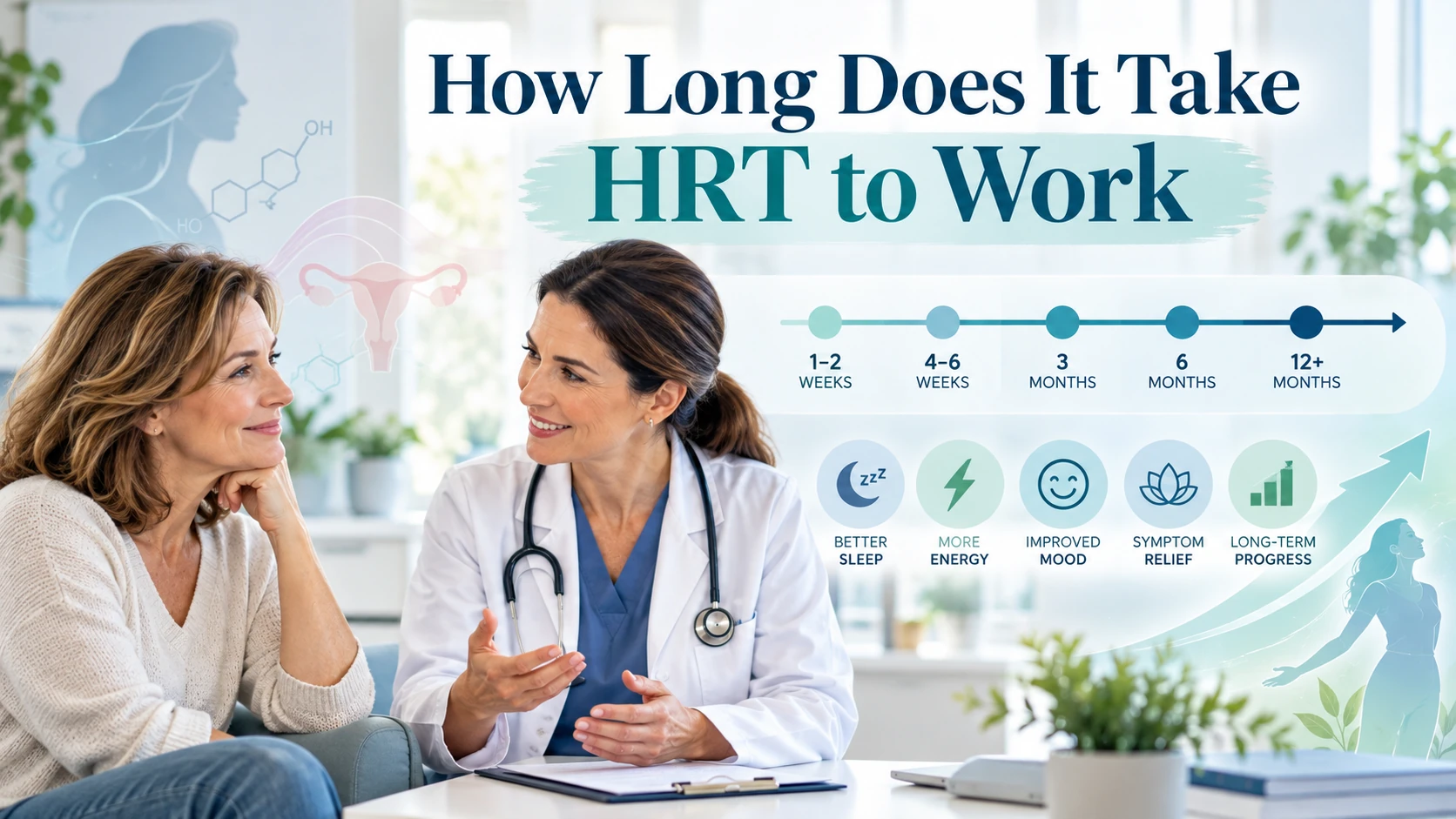
Most people notice the first changes from hormone replacement therapy within two to six weeks, especially fewer hot flashes and better sleep.

Full results, including steadier mood, stronger libido, and long-term bone protection, usually take three to six months.

The exact timeline depends on your dose, delivery method, and which symptoms bother you most.

If you just started HRT, or you’re thinking about starting, the waiting is the hardest part.

You want to know when the night sweats will stop interrupting your sleep, when your mood will feel steady again, and whether the dose you’re on is actually the right one.

The honest answer is that how long it takes HRT to work depends on what symptom you’re tracking.

Some changes show up in days.

Others take months to fully settle in.

Here’s what a realistic week-by-week and symptom-by-symptom timeline actually looks like.


SEE IF HRT IS RIGHT FOR YOU


How Long Does It Take HRT to Work?

Most people feel some relief from hormone replacement therapy within two to six weeks of starting, particularly for hot flashes, night sweats, and sleep.

Full benefits, like stable mood, improved libido, and bone protection, generally take three to six months to develop.

Hormone therapy is considered the most effective treatment available for these menopause symptoms, according to the North American Menopause Society’s 2022 position statement, though the exact timeline varies by person, dose, and delivery method.

A study published in Mayo Clinic Proceedings found that hormone therapy produced statistically significant symptom improvement after three months compared with a placebo group.

That three month mark is a useful benchmark.

It’s roughly when your provider will check in to see whether your current dose is working or needs adjusting.

At PRIME Medicine, that’s one reason hormone replacement therapy for women starts with bloodwork and a built-in follow-up visit, not just a prescription and a goodbye.


What Happens Week by Week After You Start HRT?

Hormone levels don’t flip like a switch.

Your body adjusts gradually as estrogen, progesterone, or testosterone levels rise and stabilize.

Here’s roughly what that adjustment looks like, though your own timeline may run faster or slower.

Weeks 1 to 2

Early on, some people notice fewer or milder hot flashes within the first couple of weeks, especially on faster-absorbing delivery methods like patches or gels.

Sleep may start to improve simply because fewer night sweats are waking you up.

Mood and energy usually haven’t caught up yet.

Weeks 3 to 6

This is often when the biggest jump happens.

Hot flashes and night sweats continue to ease, and many people notice steadier mood as hormone levels settle into a more consistent range.

For those on testosterone therapy, this is also around when improvements in sexual desire typically begin to emerge.

Weeks 8 to 12

By two to three months, most of the symptoms that brought you to HRT in the first place, hot flashes, sleep disruption, mood swings, should be noticeably better.

This is the point where providers typically schedule a check-in to review bloodwork and decide if your dose needs fine-tuning.

Months 3 to 6

The slower-moving benefits show up here.

Vaginal dryness and discomfort during sex usually need the full three to six month window to fully resolve.

Bone protection also builds gradually with continued use.

Research on stopping hormone therapy shows it can trigger rapid bone loss similar to what happens in the first two years after menopause, which is one reason the benefits of HRT after 65 include long-term fracture protection, not just symptom relief.


Does the Type of HRT Change How Fast It Works?

Yes.

Patches, gels, and injections typically work faster than pills because they deliver hormones directly into your bloodstream through the skin.

Oral estrogen has to pass through your liver first, which delays and reduces how much actually reaches your system.

The dose and type of hormone matter just as much as the delivery method itself.

This is partly why a one-size prescription rarely fits everyone.

A dose that works well as a patch might need adjusting if you switch to a pill, and vice versa.

It’s one reason an individualized hormone optimization plan, built around your bloodwork instead of a standard starting dose, tends to get people to relief faster.


How Long Does HRT Take to Work for Specific Symptoms?

The week-by-week timeline is a helpful average, but symptoms don’t all improve at the same pace.

Some, like vaginal changes related to what’s clinically known as genitourinary syndrome of menopause, follow their own separate clock.

Here’s how the most common symptoms tend to break down.

Hot Flashes and Night Sweats

These usually respond first.

Hormone therapy is widely considered the most effective treatment for hot flashes and night sweats, and many people notice a real difference within the first few weeks, with continued improvement through week six.

Sleep

Sleep often improves alongside hot flashes, since fewer night sweats mean fewer wakeups.

Some people also fall asleep more easily as anxiety eases.

If sleeping better is your main goal, this is usually one of the earliest wins.

Mood and Anxiety

Mood tends to follow a few weeks behind physical symptoms, often stabilizing somewhere between four and twelve weeks as hormone levels even out.

If you also deal with low estrogen symptoms like irritability or low motivation, expect gradual rather than overnight improvement here.

Brain Fog and Memory

Cognitive symptoms are usually the slowest to shift.

Most people need two to three months before they notice they can think more clearly and hold focus longer.

Libido and Sexual Health

For testosterone therapy specifically, clinical guidance on prescribing testosterone for women notes that improvements in desire typically show up within three to six weeks, though it can take longer for some.

If there’s been no real change after six months, continuing testosterone therapy alone is unlikely to help further, and it’s worth revisiting your plan.

Supporting your overall sexual health often involves more than hormones alone.

Vaginal Dryness

This symptom usually takes longer because vaginal tissue needs sustained estrogen exposure to rebuild.

Guidelines from the American Urological Association note that symptoms typically begin easing within a few weeks, with fuller improvement over eight to twelve weeks of consistent use.

The North American Menopause Society confirms that low-dose vaginal estrogen relieves dryness and discomfort with regular use over several weeks to months.

Joint Pain

Joint aches connected to dropping estrogen levels tend to improve slowly and unevenly.

Some people notice less stiffness within a couple of months, though whether HRT helps joint pain specifically can depend on what else is contributing to it, like activity level or other inflammatory conditions.


What Can Slow Down How Fast HRT Works?

A dose that’s too low for your body, an oral form losing potency to liver metabolism, inconsistent use, and other overlapping health issues can all delay how fast HRT works.

Age and how long you’ve been in menopause can also play a role, since hormone receptors can take longer to respond after years without estrogen.

Thyroid problems, chronic stress, and poor sleep habits can all mimic or mask menopause symptoms, making it harder to tell whether your hormone therapy is actually working or whether something else needs attention.

This is also one reason changes in your menstrual cycle during perimenopause can make it tricky to separate hormone therapy effects from natural fluctuations.


What If HRT Doesn’t Seem to Be Working Yet?

If it’s been less than eight to twelve weeks, it’s usually still too early to judge.

Most providers recommend giving a new dose at least two to three months before deciding it isn’t working.

If you’ve passed that window with little improvement, the most common next step is a dose or delivery method adjustment, not switching treatments entirely.

Bloodwork is the best way to find out what’s actually happening, since symptoms alone don’t always reflect your hormone levels accurately.

If you’re wondering whether you need a higher dose of HRT, that’s exactly the kind of question a follow-up visit and lab work are meant to answer.


GET HELP WITH YOUR HRT TREATMENT


How PRIME Medicine Personalizes Your HRT Timeline

At PRIME Medicine in Corona Del Mar, HRT starts with a full picture of your hormone levels, not a guess.

Our naturopathic and medical doctors review bloodwork, symptoms, and health history together before recommending a starting dose and delivery method.

Because everyone’s timeline looks a little different, we schedule follow-up visits around the same eight to twelve week window where most people start noticing real change.

That’s when we adjust dose, switch delivery methods if needed, or confirm things are on track.

Patients across Orange County work with the same team of providers throughout that process, rather than starting over with someone new at each visit.

If you’re curious whether a clinic near you offers this kind of ongoing, personalized approach, you can see all of our Orange County locations and what each one offers.


Signs Your HRT Is Working

The clearest signs HRT is working are fewer and milder hot flashes, better sleep, steadier mood, improved focus, and a return of interest in sex.

Skin and hair often feel less dry, and joint aches may ease as well.

These changes usually build gradually over the first three months rather than appearing all at once.

  • Hot flashes and night sweats happen less often and feel less intense
  • You fall asleep more easily and wake up fewer times overnight
  • Mood feels more even, with fewer sudden dips or irritability
  • Focus and memory feel sharper than they did before starting
  • Vaginal dryness and discomfort during sex start to ease
  • Joint stiffness feels less noticeable, especially in the morning

Many people stay on hormone therapy well beyond the initial adjustment period once these benefits kick in.

If you’re wondering how long that typically continues, staying on HRT long-term is a common and reasonable path for a lot of women, as long as it’s monitored.

Hormone replacement therapy isn’t instant, but it isn’t a guessing game either.

Most people feel meaningful relief within six to twelve weeks and see full results by six months, especially with a dose and delivery method matched to their own bloodwork.

If you’re in Orange County and ready to find out what your own timeline could look like, PRIME Medicine can build a plan around your hormone levels instead of a one-size-fits-all starting point.


SCHEDULE A CONSULTATION


FAQs: How Long Does It Take HRT to Work

How long does bioidentical HRT take to work compared to synthetic hormones?

Bioidentical and synthetic hormone therapy generally follow a similar timeline, with early changes in the first few weeks and fuller effects by three to six months. The bigger factor in speed is usually the delivery method and dose, not whether the hormone is bioidentical or synthetic.

Can HRT start working in the first week?

It’s possible, especially with faster-absorbing patches or gels. Some people notice fewer hot flashes within the first week or two, though this varies a lot from person to person.

Why do I feel worse before I feel better on HRT?

Some people notice mild bloating, breast tenderness, or spotting in the first few weeks as their body adjusts to new hormone levels. These effects are usually temporary and tend to settle within six to eight weeks.

How long should I wait before changing my HRT dose?

Most providers recommend waiting at least eight to twelve weeks before adjusting a dose, since it takes that long for hormone levels to stabilize and symptoms to fully respond.

Does testosterone therapy for women take longer to work than estrogen?

Often, yes. Estrogen-related symptoms like hot flashes tend to improve within weeks, while testosterone’s effects on libido typically take three to six weeks to begin and can take several months to fully develop.

How long do HRT side effects last?

Most initial side effects, like breast tenderness or mild nausea, ease within the first six to eight weeks as your body adjusts. Side effects that continue past three months are worth discussing with your provider.

Benefits of HRT After 65

Hormone replacement therapy can still support bone, heart, and brain health well after age 65, but the benefits depend on your history with HRT and how it’s delivered.

Women who continue treatment they already started tend to see different outcomes than those starting for the first time.

The safest path is an individualized evaluation, not a hard age cutoff.

For decades, doctors told women the same thing: stop hormone therapy by 60, or 65 at the latest.

That advice is changing.

New research on the benefits of HRT after 65 shows that age alone isn’t the deciding factor it was once thought to be, and for many women, hormone therapy still offers real, measurable benefits well into their late 60s, 70s, and beyond.


SEE IF HRT IS RIGHT FOR YOU


Can You Still Benefit From HRT After Age 65?

Yes, many women still benefit from HRT after 65, though the benefit depends on whether they are continuing treatment already underway or starting fresh, and on how the hormones are delivered.

Research shows transdermal and vaginal forms tend to carry a better benefit-to-risk balance than oral pills at this age.

The North American Menopause Society no longer treats 65 as an automatic stopping point.

Its current guidance supports continuing hormone therapy beyond that age for women with persistent symptoms, quality of life concerns, or bone protection needs, as long as they’ve had an individualized risk review.

A 20-year follow-up of the Women’s Health Initiative found no increase in deaths from breast cancer or cardiovascular disease among women who used hormone therapy during the original trial, which has helped shift the conversation away from blanket fear and toward individualized care.


What Are the Main Benefits of HRT After 65?

The main benefits of HRT after 65 include stronger bones, potential cardiovascular protection, support for brain health, relief from hot flashes and vaginal symptoms, and better sleep and mood.

How much you gain from each depends on the type of hormone, the dose, and how it’s taken.

Stronger Bones and Lower Fracture Risk

Bone loss speeds up after menopause, and women can lose a meaningful share of their bone density within just a few years of their final period.

Estrogen helps slow that loss by supporting the cells that rebuild bone tissue.

For women who already have thinning bones, hormone therapy used after 65 can still help protect what bone density remains, even though it isn’t usually the first treatment chosen for someone starting osteoporosis care from scratch at this age.

Heart and Metabolic Health

A study that followed 10 million women on Medicare between 2007 and 2020 found that estrogen used beyond age 65 was linked to a 19 percent reduction in mortality risk, along with lower rates of heart failure and other cardiovascular events, compared with women who didn’t use it.

The protective effect was strongest with vaginal and transdermal estrogen rather than oral pills.

These findings matter most for women who are already focused on their cardiovascular health through diet, exercise, and blood pressure management, since hormone therapy is one piece of a bigger picture, not a replacement for it.

Brain Health and Cognitive Protection

Estrogen receptors are present throughout the brain, which is part of why hormone levels can affect memory, focus, and mood.

The same Medicare study found that estrogen use after 65 was associated with a lower rate of dementia diagnoses, and some researchers believe hormone therapy may help preserve cognitive function over time when it fits a woman’s overall health picture.

This research is still developing, though, and it does not mean hormone therapy can prevent or treat dementia on its own.

Relief From Hot Flashes, Sleep Problems, and Vaginal Symptoms

Hot flashes don’t always stop after 60.

Research presented at a 2024 Menopause Society conference found that roughly 40 percent of women in their 60s and 10 to 15 percent of women in their 70s still experience hot flashes, and most participants in that study who stopped hormone therapy started it again once their symptoms came back.

Hormone therapy also treats symptoms of low estrogen like vaginal dryness, burning, and urinary urgency, sometimes called genitourinary syndrome of menopause, which tends to get worse rather than better with age if left untreated.

Because night sweats are one of the biggest sleep disruptors at this age, easing them often brings deeper, more consistent sleep as a side effect of treating the underlying cause.

Better Mood and Quality of Life

Sleep loss, hot flashes, and vaginal discomfort all take a toll on daily life, and that toll adds up over the years.

Women managing these symptoms often also deal with joint pain and stiffness that can make hormone-related mood changes feel even heavier.

Addressing the physical symptoms with hormone therapy often improves sleep and mood simply by removing the things that were disrupting them in the first place.


Starting HRT After 65 vs. Continuing Treatment You Already Started

Most of the research on hormone therapy risk is really about when someone starts, not just how old they are.

A retrospective study that followed more than 83,000 women for 22 years found that women who began hormone therapy for the first time at 65 or older had more than double the risk of certain cancers and stroke compared with women who started earlier.

That is a real risk, and it should factor into any decision to start hormone therapy from scratch at this age.

Women who are already on hormone therapy and want to continue past 65 are in a different situation.

The Medicare study of 10 million women looked specifically at continued use and found risk reductions across several cancers and cardiovascular outcomes, not increases.

This is part of why whether you can safely stay on hormone therapy long term depends heavily on your own history with it, not a universal rule that applies to every woman the same way.


Does the Type of Hormone Therapy Change the Benefits?

Yes.

Vaginal and transdermal (patch or gel) estrogen are linked to larger benefits and lower risks than oral pills after 65, and lower doses tend to outperform higher ones.

The same hormone can carry a different risk profile depending on how it enters the body.

In the full Medicare study breakdown by delivery method, vaginal estrogen was linked to about a 30 percent reduction in mortality risk, transdermal to about 20 percent, and oral estrogen to about 11 percent, all compared with women who weren’t using estrogen.

Lower doses were associated with better outcomes than medium or high doses across the board.

This matters because many women assume all hormone therapy carries the same risk.

In practice, the route of delivery changes how the hormone moves through the body.

Oral estrogen passes through the liver first, which can raise clotting factors, while patches, gels, and vaginal preparations bypass that step.

Women who need a higher dose of HRT for symptom relief should talk with their provider about whether a different delivery method could offer the same benefit at a lower dose.


What Risks Should You Weigh Against the Benefits?

The main risks of HRT after 65 include a higher chance of blood clots, stroke, and certain cancers, especially with oral estrogen and especially for women starting treatment for the first time at this age.

These risks are generally lower with transdermal or vaginal forms and lower doses, and they need to be weighed against your personal and family health history.

Those core risks, blood clots, stroke, and certain cancers, tend to run higher with oral estrogen than with patches, gels, or vaginal forms.

As covered above, starting hormone therapy for the first time at this age carries more of that risk than continuing treatment you’re already tolerating well.

None of this means hormone therapy is off the table after 65.

It means the decision needs a full picture: your cardiovascular history, your cancer risk factors, your bone health, and how you’re taking the hormone.

The North American Menopause Society continues to recommend individualized risk-benefit counseling rather than a fixed age cutoff for every woman.


How PRIME Medicine Evaluates Whether HRT After 65 Is Right for You

At PRIME Medicine in Orange County, we don’t start every patient on the same dose or the same delivery method.

Hormone therapy after 65 calls for a closer look, not a shortcut.

Our approach starts with a full conversation about your symptoms, your medical history, and what matters most to you, whether that’s sleeping through the night, protecting your bones, or simply feeling like yourself again.

From there, we run bloodwork and specialty testing to see where your hormone levels actually stand, rather than guessing based on age alone.

If hormone therapy makes sense for you, we build a personalized hormone therapy program around the lowest effective dose and the delivery method that fits your health profile, often starting with transdermal or vaginal options given what the research shows about their safety profile after 65.

We also monitor you over time and adjust as your body and your needs change, because a plan that was right at 66 might need to shift by 70.

Women throughout Newport Beach, Irvine, and the rest of Orange County come to us because this isn’t a one-size-fits-all clinic.

We’d rather spend the extra time getting your plan right than hand you a prescription and send you on your way.


CONTACT US


How Do You Know If HRT After 65 Is Right for You?

HRT after 65 is worth considering if you have persistent menopause symptoms, bone density concerns, or were already on hormone therapy and tolerating it well, and you don’t have a history that raises your clotting, cancer, or cardiovascular risk.

A provider can only answer this with bloodwork and a full health review, not a quiz or a guess.

Ask yourself a few honest questions.

Are your symptoms still affecting your sleep, your relationships, or your daily comfort?

Have you already been on hormone therapy and done well with it?

Do you have a personal or family history of blood clots, stroke, breast cancer, or heart disease?

Your answers don’t settle anything on their own, but they shape the conversation you should have with a provider who can order the right labs and walk through your specific risk factors.

That conversation matters more than any single study, because the research on hormone therapy after 65 is really a collection of averages, and you are not an average.

Hormone therapy after 65 isn’t the simple yes or no it was once treated as.

For many women, especially those continuing treatment they already started, the benefits for bone, heart, brain, and daily comfort are real and well supported by current research.

For women considering starting fresh at this age, the decision calls for a closer look at personal risk.

Either way, the right next step is an individualized evaluation, not a guess based on age alone.

PRIME Medicine’s providers in Orange County can walk you through what your own labs and history actually show, and help you decide if hormone therapy fits your health goals.


SCHEDULE A CONSULTATION


FAQs: Benefits of HRT After 65

Is it too late to start HRT after 65?

Not necessarily, but starting hormone therapy for the first time after 65 carries more risk than continuing treatment you began earlier. Research links new initiation at this age to a higher chance of cancer and stroke, so starting fresh after 65 requires a careful individual risk review with your provider, not a routine prescription.

What type of hormone therapy is safest after 65?

Vaginal and transdermal (patch or gel) estrogen are generally linked to lower risks than oral pills after 65, largely because they skip the liver processing that raises clotting factors. Lower doses are also associated with better safety outcomes than higher ones.

Can HRT help prevent osteoporosis in women over 65?

Hormone therapy can help slow bone loss and protect existing bone density in women over 65, but it’s usually not the first treatment chosen for someone starting osteoporosis treatment from scratch at this age. It’s more commonly used to protect bone in women who are already on hormone therapy for symptom relief.

Do I need to stop HRT at a certain age?

No single age applies to every woman. Current guidance from the North American Menopause Society supports continuing hormone therapy beyond 60 or 65 for women with persistent symptoms or bone health needs, as long as they’ve had an individualized risk evaluation with their provider.

What tests are needed before starting or continuing HRT after 65?

A full evaluation typically includes bloodwork to check hormone levels, a review of personal and family health history, and screening for cardiovascular, clotting, and cancer risk factors. These results guide the dose and delivery method a provider recommends.

Can HRT improve memory or brain health in older women?

Some research links hormone therapy use after 65 to lower rates of dementia diagnosis, and estrogen is known to interact with receptors throughout the brain. This research is still developing, though, and hormone therapy should not be considered a treatment or prevention strategy for dementia on its own.