
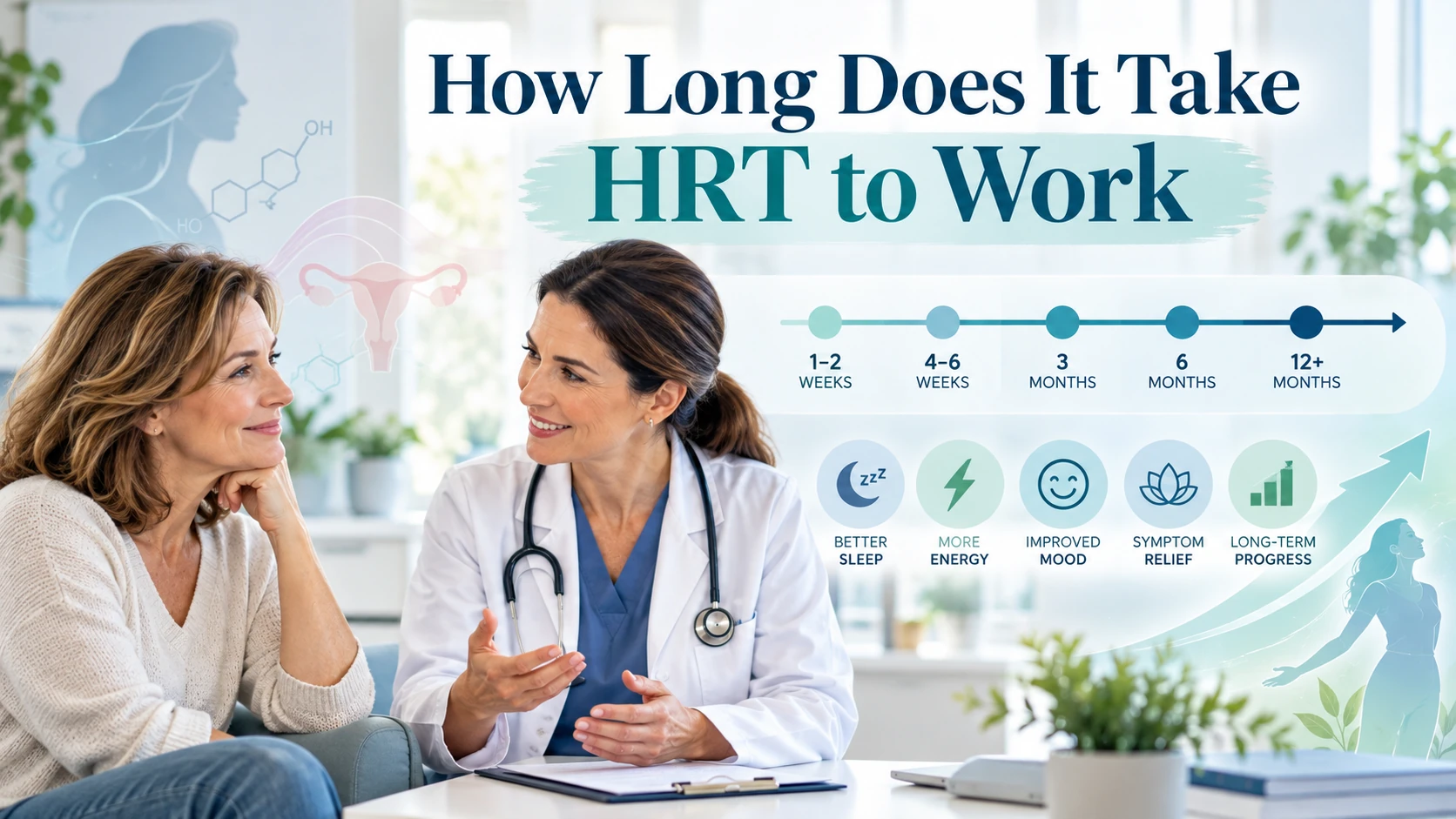
Most people notice the first changes from hormone replacement therapy within two to six weeks, especially fewer hot flashes and better sleep.
Full results, including steadier mood, stronger libido, and long-term bone protection, usually take three to six months.
The exact timeline depends on your dose, delivery method, and which symptoms bother you most.
If you just started HRT, or you’re thinking about starting, the waiting is the hardest part.
You want to know when the night sweats will stop interrupting your sleep, when your mood will feel steady again, and whether the dose you’re on is actually the right one.
The honest answer is that how long it takes HRT to work depends on what symptom you’re tracking.
Some changes show up in days.
Others take months to fully settle in.
Here’s what a realistic week-by-week and symptom-by-symptom timeline actually looks like.
How Long Does It Take HRT to Work?
Most people feel some relief from hormone replacement therapy within two to six weeks of starting, particularly for hot flashes, night sweats, and sleep.
Full benefits, like stable mood, improved libido, and bone protection, generally take three to six months to develop.
Hormone therapy is considered the most effective treatment available for these menopause symptoms, according to the North American Menopause Society’s 2022 position statement, though the exact timeline varies by person, dose, and delivery method.
A study published in Mayo Clinic Proceedings found that hormone therapy produced statistically significant symptom improvement after three months compared with a placebo group.
That three month mark is a useful benchmark.
It’s roughly when your provider will check in to see whether your current dose is working or needs adjusting.
At PRIME Medicine, that’s one reason hormone replacement therapy for women starts with bloodwork and a built-in follow-up visit, not just a prescription and a goodbye.
What Happens Week by Week After You Start HRT?
Hormone levels don’t flip like a switch.
Your body adjusts gradually as estrogen, progesterone, or testosterone levels rise and stabilize.
Here’s roughly what that adjustment looks like, though your own timeline may run faster or slower.
Weeks 1 to 2
Early on, some people notice fewer or milder hot flashes within the first couple of weeks, especially on faster-absorbing delivery methods like patches or gels.
Sleep may start to improve simply because fewer night sweats are waking you up.
Mood and energy usually haven’t caught up yet.
Weeks 3 to 6
This is often when the biggest jump happens.
Hot flashes and night sweats continue to ease, and many people notice steadier mood as hormone levels settle into a more consistent range.
For those on testosterone therapy, this is also around when improvements in sexual desire typically begin to emerge.
Weeks 8 to 12
By two to three months, most of the symptoms that brought you to HRT in the first place, hot flashes, sleep disruption, mood swings, should be noticeably better.
This is the point where providers typically schedule a check-in to review bloodwork and decide if your dose needs fine-tuning.
Months 3 to 6
The slower-moving benefits show up here.
Vaginal dryness and discomfort during sex usually need the full three to six month window to fully resolve.
Bone protection also builds gradually with continued use.
Research on stopping hormone therapy shows it can trigger rapid bone loss similar to what happens in the first two years after menopause, which is one reason the benefits of HRT after 65 include long-term fracture protection, not just symptom relief.
Does the Type of HRT Change How Fast It Works?
Yes.
Patches, gels, and injections typically work faster than pills because they deliver hormones directly into your bloodstream through the skin.
Oral estrogen has to pass through your liver first, which delays and reduces how much actually reaches your system.
The dose and type of hormone matter just as much as the delivery method itself.
This is partly why a one-size prescription rarely fits everyone.
A dose that works well as a patch might need adjusting if you switch to a pill, and vice versa.
It’s one reason an individualized hormone optimization plan, built around your bloodwork instead of a standard starting dose, tends to get people to relief faster.
How Long Does HRT Take to Work for Specific Symptoms?
The week-by-week timeline is a helpful average, but symptoms don’t all improve at the same pace.
Some, like vaginal changes related to what’s clinically known as genitourinary syndrome of menopause, follow their own separate clock.
Here’s how the most common symptoms tend to break down.
Hot Flashes and Night Sweats
These usually respond first.
Hormone therapy is widely considered the most effective treatment for hot flashes and night sweats, and many people notice a real difference within the first few weeks, with continued improvement through week six.
Sleep
Sleep often improves alongside hot flashes, since fewer night sweats mean fewer wakeups.
Some people also fall asleep more easily as anxiety eases.
If sleeping better is your main goal, this is usually one of the earliest wins.
Mood and Anxiety
Mood tends to follow a few weeks behind physical symptoms, often stabilizing somewhere between four and twelve weeks as hormone levels even out.
If you also deal with low estrogen symptoms like irritability or low motivation, expect gradual rather than overnight improvement here.
Brain Fog and Memory
Cognitive symptoms are usually the slowest to shift.
Most people need two to three months before they notice they can think more clearly and hold focus longer.
Libido and Sexual Health
For testosterone therapy specifically, clinical guidance on prescribing testosterone for women notes that improvements in desire typically show up within three to six weeks, though it can take longer for some.
If there’s been no real change after six months, continuing testosterone therapy alone is unlikely to help further, and it’s worth revisiting your plan.
Supporting your overall sexual health often involves more than hormones alone.
Vaginal Dryness
This symptom usually takes longer because vaginal tissue needs sustained estrogen exposure to rebuild.
Guidelines from the American Urological Association note that symptoms typically begin easing within a few weeks, with fuller improvement over eight to twelve weeks of consistent use.
The North American Menopause Society confirms that low-dose vaginal estrogen relieves dryness and discomfort with regular use over several weeks to months.
Joint Pain
Joint aches connected to dropping estrogen levels tend to improve slowly and unevenly.
Some people notice less stiffness within a couple of months, though whether HRT helps joint pain specifically can depend on what else is contributing to it, like activity level or other inflammatory conditions.
What Can Slow Down How Fast HRT Works?
A dose that’s too low for your body, an oral form losing potency to liver metabolism, inconsistent use, and other overlapping health issues can all delay how fast HRT works.
Age and how long you’ve been in menopause can also play a role, since hormone receptors can take longer to respond after years without estrogen.
Thyroid problems, chronic stress, and poor sleep habits can all mimic or mask menopause symptoms, making it harder to tell whether your hormone therapy is actually working or whether something else needs attention.
This is also one reason changes in your menstrual cycle during perimenopause can make it tricky to separate hormone therapy effects from natural fluctuations.
What If HRT Doesn’t Seem to Be Working Yet?
If it’s been less than eight to twelve weeks, it’s usually still too early to judge.
Most providers recommend giving a new dose at least two to three months before deciding it isn’t working.
If you’ve passed that window with little improvement, the most common next step is a dose or delivery method adjustment, not switching treatments entirely.
Bloodwork is the best way to find out what’s actually happening, since symptoms alone don’t always reflect your hormone levels accurately.
If you’re wondering whether you need a higher dose of HRT, that’s exactly the kind of question a follow-up visit and lab work are meant to answer.
GET HELP WITH YOUR HRT TREATMENT
How PRIME Medicine Personalizes Your HRT Timeline
At PRIME Medicine in Corona Del Mar, HRT starts with a full picture of your hormone levels, not a guess.
Our naturopathic and medical doctors review bloodwork, symptoms, and health history together before recommending a starting dose and delivery method.
Because everyone’s timeline looks a little different, we schedule follow-up visits around the same eight to twelve week window where most people start noticing real change.
That’s when we adjust dose, switch delivery methods if needed, or confirm things are on track.
Patients across Orange County work with the same team of providers throughout that process, rather than starting over with someone new at each visit.
If you’re curious whether a clinic near you offers this kind of ongoing, personalized approach, you can see all of our Orange County locations and what each one offers.
Signs Your HRT Is Working
The clearest signs HRT is working are fewer and milder hot flashes, better sleep, steadier mood, improved focus, and a return of interest in sex.
Skin and hair often feel less dry, and joint aches may ease as well.
These changes usually build gradually over the first three months rather than appearing all at once.
- Hot flashes and night sweats happen less often and feel less intense
- You fall asleep more easily and wake up fewer times overnight
- Mood feels more even, with fewer sudden dips or irritability
- Focus and memory feel sharper than they did before starting
- Vaginal dryness and discomfort during sex start to ease
- Joint stiffness feels less noticeable, especially in the morning
Many people stay on hormone therapy well beyond the initial adjustment period once these benefits kick in.
If you’re wondering how long that typically continues, staying on HRT long-term is a common and reasonable path for a lot of women, as long as it’s monitored.
Hormone replacement therapy isn’t instant, but it isn’t a guessing game either.
Most people feel meaningful relief within six to twelve weeks and see full results by six months, especially with a dose and delivery method matched to their own bloodwork.
If you’re in Orange County and ready to find out what your own timeline could look like, PRIME Medicine can build a plan around your hormone levels instead of a one-size-fits-all starting point.
FAQs: How Long Does It Take HRT to Work
How long does bioidentical HRT take to work compared to synthetic hormones?
Bioidentical and synthetic hormone therapy generally follow a similar timeline, with early changes in the first few weeks and fuller effects by three to six months. The bigger factor in speed is usually the delivery method and dose, not whether the hormone is bioidentical or synthetic.
Can HRT start working in the first week?
It’s possible, especially with faster-absorbing patches or gels. Some people notice fewer hot flashes within the first week or two, though this varies a lot from person to person.
Why do I feel worse before I feel better on HRT?
Some people notice mild bloating, breast tenderness, or spotting in the first few weeks as their body adjusts to new hormone levels. These effects are usually temporary and tend to settle within six to eight weeks.
How long should I wait before changing my HRT dose?
Most providers recommend waiting at least eight to twelve weeks before adjusting a dose, since it takes that long for hormone levels to stabilize and symptoms to fully respond.
Does testosterone therapy for women take longer to work than estrogen?
Often, yes. Estrogen-related symptoms like hot flashes tend to improve within weeks, while testosterone’s effects on libido typically take three to six weeks to begin and can take several months to fully develop.
How long do HRT side effects last?
Most initial side effects, like breast tenderness or mild nausea, ease within the first six to eight weeks as your body adjusts. Side effects that continue past three months are worth discussing with your provider.